How many of you know the true secret, the Rahasya of the legendary Chidambaram Temple? It’s a secret about nothing—a space where Shiva dances in the form of pure ether, a void that is, paradoxically, everything.
Just a year ago, this concept of nothingness (Telugu: శూన్యం) was the unlikely starting point for my spiritual journey with my G.
Out of Nothing, Everything Manifested
Life was simply the daily routine: cook, work, sleep, eat, chat, clean. There was no grand plan for travel. We had no set vacation time carved out, no dedicated budget, and frankly, no great health to speak of. We started with literally nothing arranged.
Yet, this journey—from nothing to everything—is the true meaning of the Chidambaram secret.
It began with one simple, pure thought in G’s mind: a desire to visit Kailash. From that single seed of intention, everything miraculously fell into place. Our journey expanded to include the most sacred spots: Varanasi, Ayodhya, and Prayagraj.
This experience taught me the deepest lesson: the true Chidambaram Rahasya is finding your inner conscience and letting that conscience find you everything you need.
Measuring Faith: A Question of Duty
This entire experience brings up a question I often ponder, especially regarding my role as a wife: Is it enough to be a “good house wife” if you only offer formal prayers twice a year?
I confess I’m not the house wife who adheres to the strict 5 AM shower and daily prayer routine. I fulfill my duties and do my work when I like. My formal, ritual prayers happen only on Vinayak Chavithi and during Deepavali.
I leave the judgment of this practice to each individual, as devotion is a personal measure. But for me, there is no measurement, because who are we to measure the divine?
God is in the Gratitude, Not the Asking
My faith is simple and constant: I believe in God, and God is everywhere.
I don’t need to ask Them for help when times are difficult, because They are always with me, watching over me. They know exactly what to do and when to do it.
My practice is one of constant gratitude. I think of God, fetching their names many times a day—to thank Them, to share my day with Them, to talk to Them. The moment my work is done, my first thought is appreciation for their presence and protection.
The secret of nothing—the శూన్యం—is the realization that profound devotion is not confined to grand rituals or temple visits. It is found in the simple, continuous gratitude woven into the fabric of everyday life. The small, daily acts are the prayer.
What does the concept of nothingness mean for your faith and your life? Share your thoughts below.
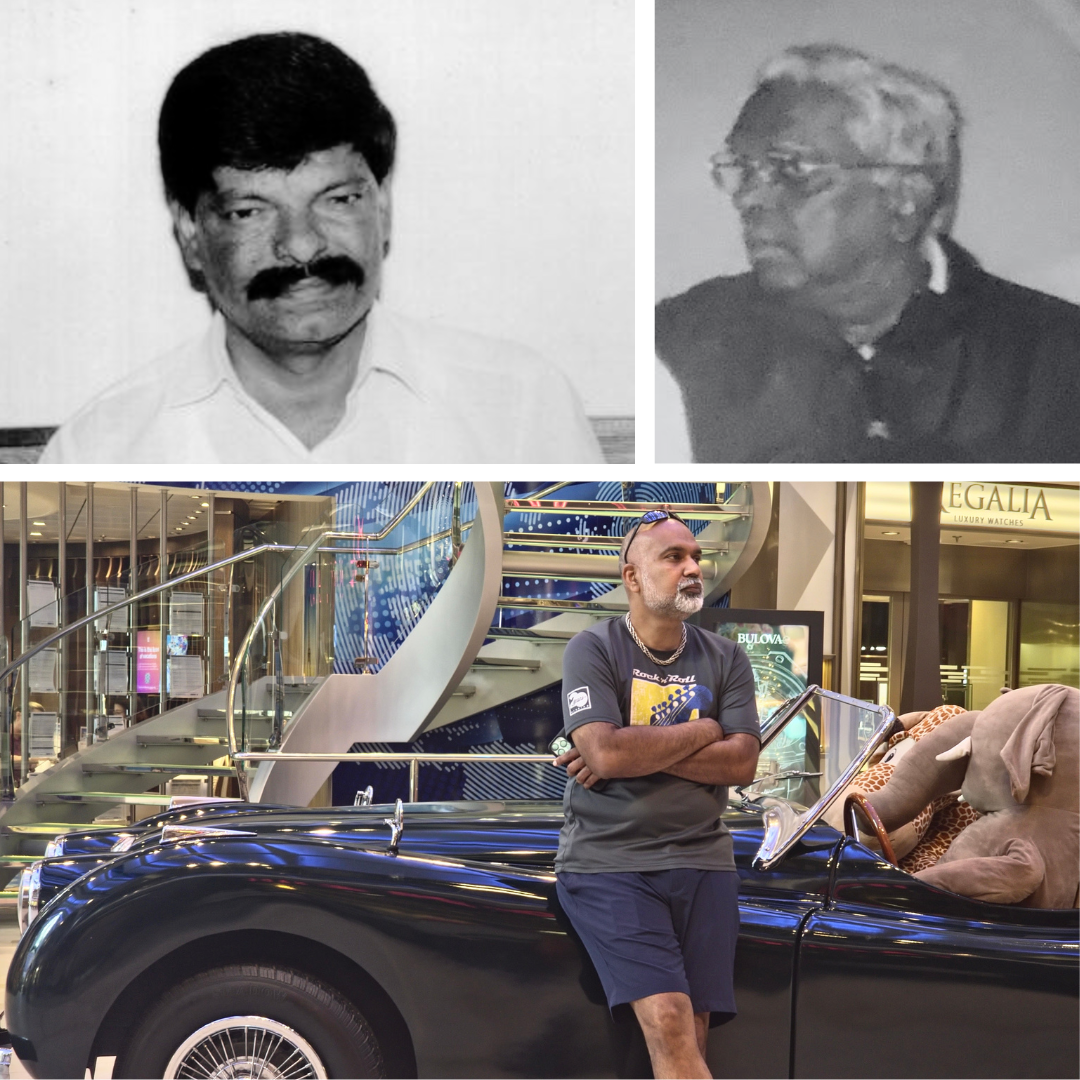
Father’s Day is a time to celebrate those incredible men who shape our lives, and for me, that journey begin with my dad. He’s more than just a father figure; he’s the one who literally gave me a space in this world, and whose presence has always been a fortress against fear.
Every morning, a gentle kiss on the forehead from a man who stands at a towering 6 feet 6 inches spoke volumes of his boundless care and unwavering support. In his presence, there was, and still is, no room for fear. He’s always been my safe harbor.
I vividly remember our secret escapades, especially our trips to eat out, which we’d often sneak out for, leaving my mom in the dark for a little while. Our favorite clandestine meal? Cashew idlis at the Maruri rooftop in Tirupati. Now, hold on before you judge! Yes, idlis. And yes, at that time, it was simply “the Maruri hotel” – the concept of a fancy “rooftop restaurant” wasn’t even in our vocabulary back then. But let me tell you, I have never tasted idlis as good as those. And no, I’m not comparing them to my mom’s delicious idlis; that’s a sacred category of its own! The sheer joy of sneaking out, savoring that food, then later confessing to my mom and receiving her playful scolding – that whole experience was, and remains, utterly priceless.
Another source of pure delight was going on rides with him on his Royal Enfield Bullet. Imagine this: in all of Tirupati, he was the only one who owned such a magnificent machine. Those rides weren’t just about the wind in our hair; they were about the bond, the adventure, and the feeling of being utterly secure with him at the helm.
But do you know the moment I saw the purest joy, the most profound love, shining in his eyes and heart? It was when I said yes to the groom he showed. His gaze, a thousand volts strong, locked onto my mom. The look he gave her, silently conveying “that is my daughter,” is a moment etched into my memory, never to be forgotten. It was a look of immense pride, of validation, and of deep, unconditional love.
So, who is this extraordinary man? He is my dad, my Nana. And I am his Ninni. He is the one and only person in this entire world who calls me Ninni. And for that, and a million other cherished moments, I am eternally grateful. Happy Father’s Day to the giants who stand tall in our lives.
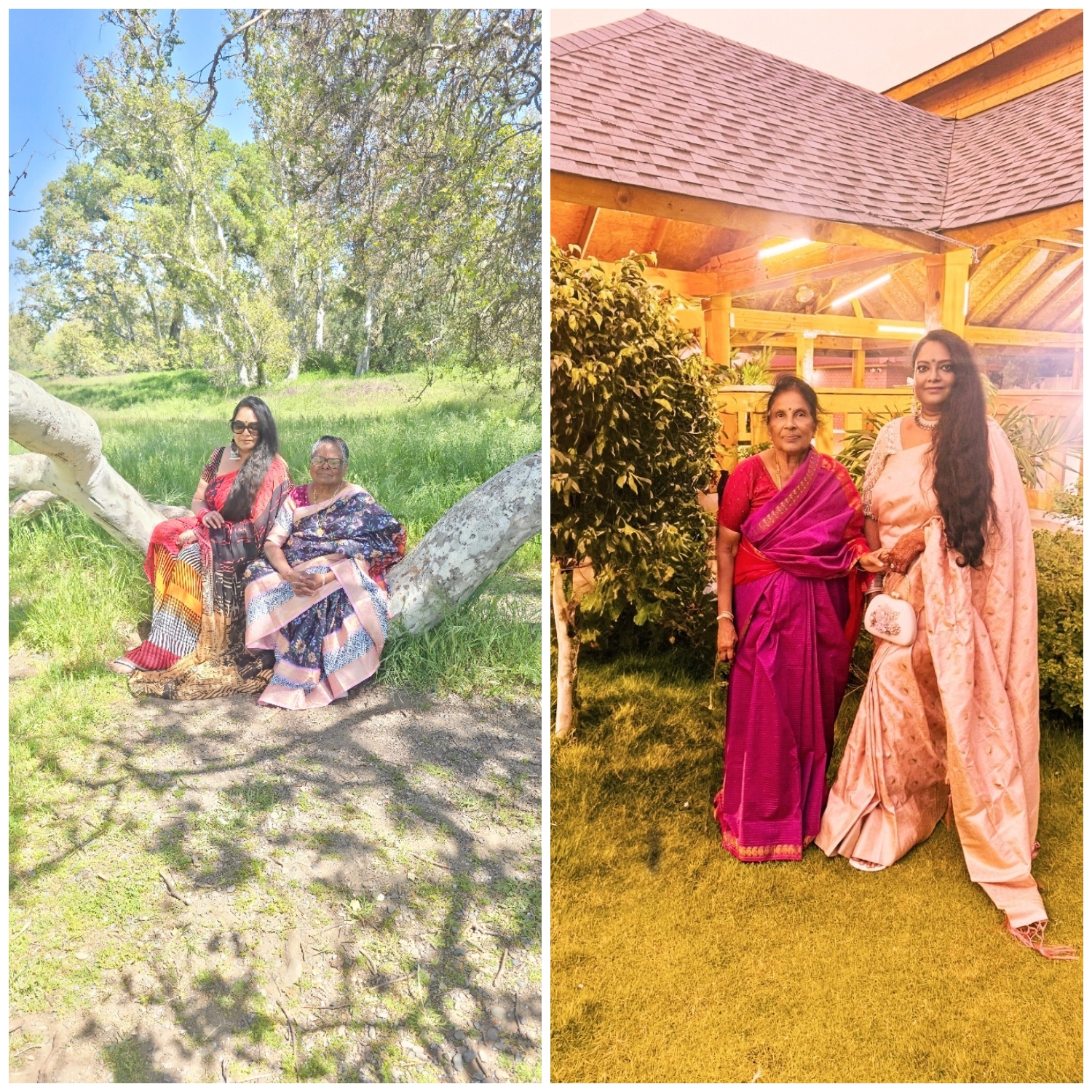
Then, I went from one home to another, and there I met a different kind of man – the Man of the Jogis, my Father-in-Law. While our interactions weren’t as frequent, it was clear that his presence was powerfully felt. He was truly one of the most respectful men I’ve ever encountered, deeply devoted to caring for his wife. He was her steadfast backbone in every aspect, even extending to the simple yet profound gesture of cutting vegetables in the kitchen. My mother-in-law was, without a doubt, the luckiest woman. One of my earliest and most cherished memories with him dates back to the very first day of my marriage. We were at my in-laws’ place, and the memorable meal we shared was “Saddi Annam” – which translates to fermented rice in English, and my kids affectionately call “Ice Biryani.” It was a dish that quickly was our favorite for both him and me. We even managed to make everyone else eat it, because people do not prefer that as it is considered poor man’s food, though I might have earned myself a spot on a “blacklist” within the first week for my zealous influence!
And then, came my husband. For nineteen years, my dad had been the unwavering hand holding mine, guiding me through life. On a momentous day, he lovingly placed my hand into the care of the one and only man he knew would bring him profound happiness – a moment eternally etched in his memory. Since that day, I’ve held onto my husband’s pinky finger, walking the seven sacred steps of marriage beside him, and following his path for over thirty years. He has been my constant guide, the illuminating light in my life, my steadfast fighter, my insightful critic, my trusted advisor – truly, he is everything. He is none other than my G.
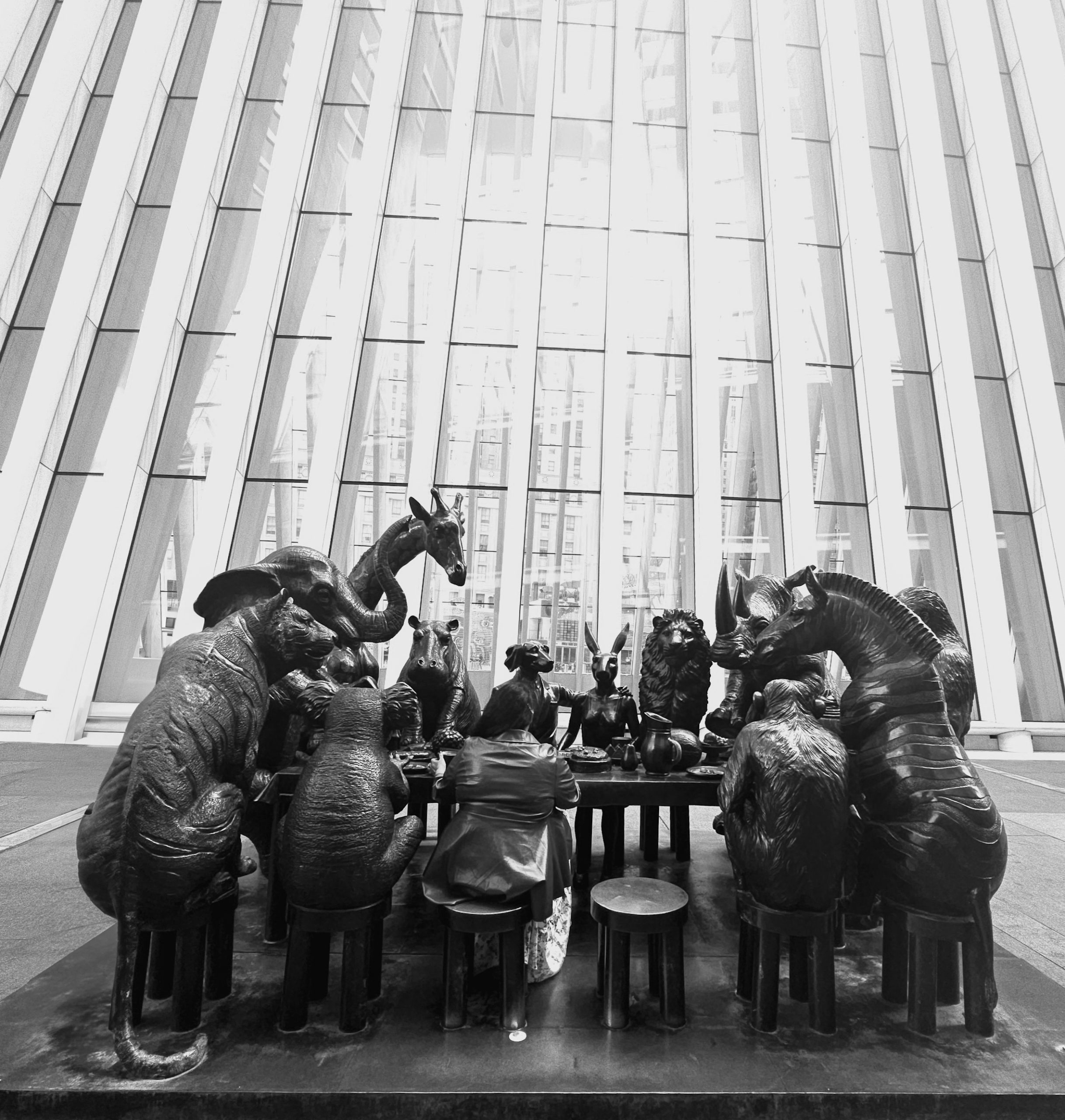
The image I shared captures a moment of profound reflection at the “Wild Table of Love” installation by Gillie and Marc at the World Trade Center Oculus. Surrounded by magnificent bronze sculptures of endangered animals, there’s an undeniable pull to the empty seats, an open invitation to join a crucial conversation about wildlife conservation, dialogue, and understanding. It’s a powerful reminder that unity, even among diverse species, is vital for survival.
As I sat there, a poignant thought struck me: What if, in our increasingly fragmented world, something as fundamental and precious as family bonding became an endangered concept?
We spend so much time advocating for the preservation of our planet’s wild inhabitants, building awareness so that majestic creatures don’t vanish from our dictionaries or our lives. But what about the bonds that define us, that shape our earliest memories, that form the bedrock of our communities? Are we actively preserving the essence of what it means to be a connected family?
Imagine a future where children grow up without understanding the comfort of a shared family meal, the strength of unconditional support, or the joy of simply being together. A future where the words “family bonding” become archaic, a quaint phrase from a bygone era, removed from our collective dictionary because the practice itself has faded.
That thought, for me, is truly unsettling. We see the signs: the increasing pull of individual screens, the demands of busy schedules, the erosion of shared moments. It’s a silent erosion, perhaps, but one that could lead us down a path where we mourn the loss of something vital, just as we mourn the loss of a species.
This isn’t about fear-mongering; it’s a heartfelt plea and an urgent invitation. Just as “The Wild Table of Love” beckons us to protect our natural world, I believe it’s time we consciously, intentionally, and passionately advocate for the preservation of our families. We need to raise awareness that fostering strong family bonds isn’t a luxury, but a necessity for individual well-being and societal health.
So, I invite you to look at that empty seat next to me at the “Wild Table of Love.” Metaphorically, join me in taking that seat to raise awareness for family bonding. Let’s commit to making time, initiating conversations, creating traditions, and simply being present for those who matter most.
Let’s raise a glass – not just to the protection of our wildlife, but to the proactive preservation of family bonding for tomorrow. So that our children, and our children’s children, will never forget what it means, and will never have to remove “family bonding” from their dictionary. It’s time to gather around our own tables, wild or otherwise, and nurture the love that truly sustains us all.
Today, I want to talk about a word that resonates deeply within each of us: Independence. But what does it truly mean to be an independent woman in today’s world? The great Telugu poet, the late Sri Sirivennela Sitarama Sastry, through his profound lyrics, offers us a vision not of isolation, but of magnificent, self-assured strength that can coexist beautifully with our cherished relationships.
There’s a common misconception that independence for a woman means she must walk alone, that she must be single, detached from the fabric of family. But let’s pause and consider this. Imagine, after India gained its hard-fought independence, if every single citizen then declared they must be individually independent from everyone else, forming their own personal ‘country.’ What would we have? Not a strong, united nation, but millions of isolated fragments.
So, to all the wonderful ladies and girls out there, let us not misunderstand or misuse the incredible power of our independence. It is not a weapon to sever ties, nor a shield to hide behind in solitude. If you can find joy, support, and happiness living with your family – your mother, father, your in-laws, your husband, your children – this does not diminish your independence. In fact, it can be the very stage upon which your independent spirit shines brightest.
Let’s draw inspiration from the breathtaking imagery penned by Sirivennela Sitarama Sastry in the lines you shared:
“Mabbullo tulutunn merupapona” – Can you feel that? “Like a lightning bolt that peeks through the clouds!” Ladies, believe that you possess this inherent brilliance, this power to illuminate. Your independence is that inner spark, that sudden, captivating energy that is uniquely yours. You can be that dazzling lightning bolt, a force of nature, shining your light from within.
“Vayyari vanjallai digirana” – “Shall I descend like a graceful, beautiful maiden?” This speaks to the power of shaping your life with grace and intention. True independence is the agency to mold your destiny, to carry yourself with elegance and poise, regardless of your circumstances. You can gracefully navigate your path, making choices that reflect your inner strength and beauty.
“Sandranlo pongutunn alanypona” – “Like a wave swelling in the ocean.” Be that joy in your own sea! Your independence allows you to cultivate an ocean of happiness, strength, and resilience within yourself. This inner abundance, this surging wave of positive energy, can then touch and uplift everyone around you, especially your loved ones. If you think independence is being alone, then what is the use of you being happy? If there is no one around you, you are alone, and that joy remains unshared, perhaps even diminished. True joy finds its deepest meaning when it can radiate outwards.
“Sandello rangulenno chilikena” – “Shall I sprinkle the many colors of twilight?” Your unique talents, your perspectives, your laughter, your compassion – these are the myriad colors you bring to the world. An independent spirit is free to express these colors authentically, painting her life and the lives of those she loves with vibrancy and joy.
And then, this powerful call to action: “Pillgale pallakiga dikkulanni chuttirana” – “Making the gentle breezes my palanquin, shall I roam all directions?” This is the essence of taking your life into your own hands. Take care of yourself first. Nurture your dreams, your well-being, your spirit. The gentle breeze here isn’t about a solitary journey, but about having the freedom and self-reliance to choose your direction, to explore your potential, with the world as your canvas. You are the driver of your own ‘pallaki’ (palanquin).
When you embrace this radiant, self-assured independence, when you are that lightning bolt, that graceful presence, that joyful wave, when you steer your own life with care and courage, then, as Sirivennela beautifully prophesies:
“Naa kosam navaragale natyamadanuga” – “For my sake, the ‘Navaragas’ (the nine aesthetic emotions/essences, the very fullness of life) will dance!” Everything follows. Joy, respect, love, fulfillment – they will all be drawn to your confident, self-possessed energy. The world will indeed seem to celebrate you.
For this beautiful blossoming, for this dance of life to occur, being alone is not a prerequisite. To equate solitude with independence can sometimes lead to what might be perceived as selfishness, a cutting off rather than a building up. True independence empowers you to be a stronger partner, a more understanding daughter, a more capable mother, a more supportive friend. It allows you to contribute to your family and community from a place of wholeness, not from a place of needing to prove your detachment.
So, let us redefine independence not as a departure from our relationships, but as the journey to becoming our most authentic, powerful, and radiant selves within them. Let the wisdom of Sirivennela Sitarama Sastry’s poetry inspire us to be like the lightning, the graceful maiden, the surging wave, and the master of our own journey, all while cherishing the beautiful tapestry of family and connection.
Be brilliant. Be graceful. Be joyful. Be you. And watch as the world dances for you.
To help you visualize the beautiful enactment of such powerful emotions and grace, I’ll be pointing to the iconic song featuring Bhanupriya, where these sentiments are so wonderfully portrayed.
Motherhood’s heart, a sacred flame,Whispering solace, speaking love’s true name.A boundless spirit, selfless, vast, and deep,In countless forms, a watchful soul does keep. There’s Mother Land, our strong and verdant ground,Like Bharata Mata, where our roots are bound.On her broad back, she carries all our days,A silent strength in myriad, gentle ways. Then, mother of daughter, with patient grace,A gentle hand that tends the home’s warm space.In quiet strength, she manages and serves,A love enduring, calming all our nerves. And mother-in-law, a guide so kind and true,When daughters step into a world so new.She offers wisdom, helps to light the way,Building foundations for a brighter day. A daughter, too, finds strength she didn’t know,As motherhood’s own tender seeds do grow.A universal power, reborn and bright,Giving birth to two dear boys, a wondrous light. There are mothers too, beyond their own child’s plea,Who nurture family, for all the world to see.For father, mother, sisters, brothers dear,They take the mantle, banishing all fear. And fathers, standing tall, when mothers are away,Embrace the role, to guide through night and day.With tender hands, they fill the empty space,A living testament to motherhood’s embrace. In every form, a mother’s spirit shines,Crossing boundaries, breaking all confines.For every soul who holds this sacred part,A boundless love flowing from the heart. To all who mother, in every loving role,You make us vibrant, you make us whole.With deepest thanks, our grateful hearts we raise,Wishing you a truly wonderful Mother’s Day! ~Praveena Jogi
SHARE :
“Create your own happiness, don’t find happiness.” ~Praveena Jogi
We often hear about the “pursuit of happiness,” as if it’s some elusive treasure to be found. But what if happiness isn’t something we find, but something we create? As I like to say, “Create your own happiness, don’t find happiness.”
I believe that true, lasting happiness comes from within. Whether you’re a man or a woman, you possess the power to shape your own emotional landscape. Spending your time searching for happiness outside yourself can be a time-consuming and often disappointing endeavor. You might find fleeting moments of joy in another person’s happiness, or conversely, be affected by their sadness. But these external sources are temporary and unstable.
The key to real happiness lies in your own actions, your own efforts, and your own integrity. When you work hard, stay true to your values, and cultivate self-trust, you build a foundation for happiness that no one can take away. This isn’t to say that external factors don’t play a role in our lives, but it emphasizes that our internal state is paramount.
Creating happiness also means finding joy in what we have, without disturbing the peace around us. I recently experienced this firsthand: I visited a place where peacocks roamed freely, living alongside humans. They were accustomed to the cars, the roads, and the people. And yet, one of these peacocks was so happy to dance with me in my 10-second selfie video! This is creating happiness with what I had—a beautiful creature freely expressing itself. The peacock fully opened its feather fan, came close, and performed a dance for the camera. It was clear he enjoyed being on camera!
Creating your own happiness can open doors you never imagined. It can lead to a profound sense of fulfillment and even, as some believe, a connection to something greater.
The ancient epic the Mahabharata illustrates this concept in a powerful way. Duryodhana, a complex character, is said to have experienced a moment of pure joy and satisfaction on the battlefield, even as he faced death. This wasn’t a simple, superficial expression. It was a deep acceptance of his choices and their consequences.
Now, you might ask, “Duryodhana was not a virtuous person, so how could he go to heaven?” While the epic describes his eventual fate as including a period in hell, it also acknowledges the power of that final, genuine smile. His full-hearted happiness, in that moment, had a transformative power.
This highlights the incredible power of a smile and of happiness, especially the kind you create yourself. When you take ownership of your emotional well-being and actively cultivate joy, incredible things can happen.
I’ll admit it: I’ve had a bit of a reputation. In school, at home, even after getting married, I’ve been the one known for sleeping in. You might even call me a “brand ambassador” for the late morning rise. But does that make me lazy? Not exactly. If there’s work to be done, I’m up and at it – even if it means getting up, tackling the task, and then heading back to bed. Blame it on years of being on call with a pager, training me to function at odd hours.
My dad, though, always preached the gospel of the early morning. “Get up early,” he’d say, “and reading in the morning will help your brain store information.” Back in my school days, I was so desperate to avoid those 5 AM wake-up calls that I’d bribe my sister with sarees! But his words, despite my resistance, have stuck with me. He believed that the early morning fosters focus, productivity, and the cultivation of a good habit.
Ironically, “late” for me is 7 AM. I know, some of you early birds are probably laughing! But it brings up the question: Is there really “magic” in waking up early? Some people do it to please others, to score brownie points. My dad wanted me to do it for cognitive benefits. My grandmother had a different take: in her culture, waking up early at your mother-in-law’s house was a sign of respect.
So, who’s right? Well, in my experience, there’s truth to my dad’s perspective. The brain does feel different in those early hours. It’s fresh, rested, and there are fewer distractions. You can often power through tasks with surprising speed. And there’s also the practical benefit: finishing your work early leaves you with more free time later in the day.
But is it a universally “good habit”? That’s where it gets subjective. It depends on your lifestyle, your natural rhythms, and what works best for you.
For me, the real secret to waking up in the morning? It’s simple: turn off the fan!
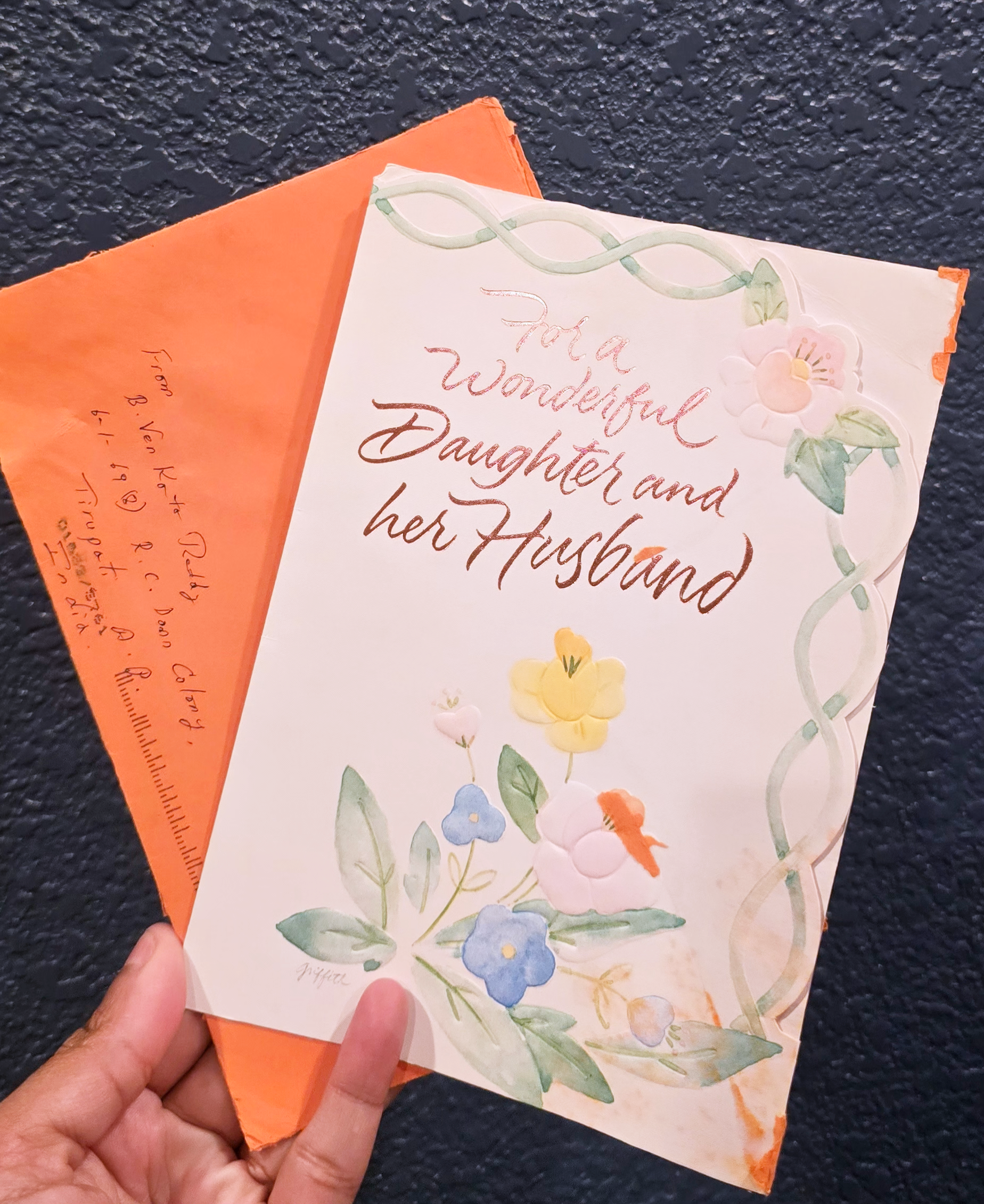
Thirty years. Thirty years of dust, memories, and forgotten corners. Who knew that a deep clean, a task often dreaded, could unearth a treasure more valuable than any gem? While tackling the clutter of our home, I stumbled upon a weathered cardboard box, its contents shrouded in the mystery of time. And inside, nestled among old photos and forgotten trinkets, were two anniversary cards.
Simple, printed cards, signed with a familiar, loving hand. My dad.
He’d been gone for nearly three decades, taken too soon, leaving a void that time could soften but never truly fill. These cards, sent to my husband and me in our fledgling years of marriage, were a whisper from the past, a tangible reminder of his love. Two years. That’s all the anniversary cards there were, because he was gone after that.
But those two cards held more than just ink and paper. They held wishes. Wishes for happiness, for enduring love, for a future he wouldn’t see. They held his blessing, a silent promise that even in his absence, his love would surround us.
And then, there was his handwriting. Oh my. His handwriting. It was like pearls on the page, delicate and precise. As I traced the loops and curves, a tear welled up in my eye. Not a tear of sorrow, but a tear of pure, unadulterated joy. To see his handwriting again, to be able to touch his wishes, was a gift beyond measure.
And the names! My dad, the only person in the world who ever called me “Nanni,” and my husband, “Nanna.” I’d completely forgotten that sweet, unique combination he’d created for us. “Nanni” and “Nanna.” It was a perfect, loving pairing, a little secret language just for us. Seeing it written there, on those cards, brought back a flood of memories, the sound of his voice echoing in my ears.
The joy of discovering these artifacts, these tangible pieces of the past, is utterly priceless. It’s a rush of emotion, a flood of memories, a warm embrace from a time long gone. It’s more valuable than a million dollars, because it’s a connection to something irreplaceable.
And it made me think. In our fast-paced, digital world, where communication is instant and fleeting, we are losing something precious. We trade heartfelt letters for hurried texts, tangible gifts for digital emojis. We send our love in ephemeral WhatsApp messages, which are often deleted, forgotten, or lost in the digital abyss.
Where is the sentiment in a disappearing message? Where is the tangible proof of love and blessing? Where is the cardboard box, filled with treasures to be discovered by future generations?
We are losing the art of keeping, of treasuring, of holding onto the moments that truly matter. We’re losing the ability to physically touch a piece of the past, to feel the weight of a memory in our hands.
My dad’s anniversary cards are a reminder. A reminder to slow down, to cherish the moments, to create tangible memories that will outlast the digital age. They’re a reminder that love, blessings, and wishes, though expressed in a simple card, are eternal.
Let’s not let the joy of discovering these kinds of artifacts fade away. Let’s create moments, tangible and real, that our loved ones can hold onto, long after we’re gone. Let’s write letters, send cards, print photos, and create physical memories that will stand the test of time.
Because in the end, it’s not the fleeting messages that matter. It’s the enduring love, the timeless blessings, and the priceless joy of discovery that truly enrich our lives. And sometimes, all it takes is a dusty cardboard box to remind us of that.
Simple, printed cards, signed with a familiar, loving hand. My dad.
He’d been gone for nearly three decades, taken too soon, leaving a void that time could soften but never truly fill. These cards, sent to my husband and me in our fledgling years of marriage, were a whisper from the past, a tangible reminder of his love. Two years. That’s all the anniversary cards there were, because he was gone after that.
But those two cards held more than just ink and paper. They held wishes. Wishes for happiness, for enduring love, for a future he wouldn’t see. They held his blessing, a silent promise that even in his absence, his love would surround us.
And then, there was his handwriting. Oh my. His handwriting. It was like pearls on the page, delicate and precise. As I traced the loops and curves, a tear welled up in my eye. Not a tear of sorrow, but a tear of pure, unadulterated joy. To see his handwriting again, to be able to touch his wishes, was a gift beyond measure.
The joy of discovering these artifacts, these tangible pieces of the past, is utterly priceless. It’s a rush of emotion, a flood of memories, a warm embrace from a time long gone. It’s more valuable than a million dollars, because it’s a connection to something irreplaceable.
And it made me think. In our fast-paced, digital world, where communication is instant and fleeting, we are losing something precious. We trade heartfelt letters for hurried texts, tangible gifts for digital emojis. We send our love in ephemeral WhatsApp messages, which are often deleted, forgotten, or lost in the digital abyss.
Where is the sentiment in a disappearing message? Where is the tangible proof of love and blessing? Where is the cardboard box, filled with treasures to be discovered by future generations?
We are losing the art of keeping, of treasuring, of holding onto the moments that truly matter. We’re losing the ability to physically touch a piece of the past, to feel the weight of a memory in our hands.
My dad’s anniversary cards are a reminder. A reminder to slow down, to cherish the moments, to create tangible memories that will outlast the digital age. They’re a reminder that love, blessings, and wishes, though expressed in a simple card, are eternal.
Let’s not let the joy of discovering these kinds of artifacts fade away. Let’s create moments, tangible and real, that our loved ones can hold onto, long after we’re gone. Let’s write letters, send cards, print photos, and create physical memories that will stand the test of time.
Because in the end, it’s not the fleeting messages that matter. It’s the enduring love, the timeless blessings, and the priceless joy of discovery that truly enrich our lives. And sometimes, all it takes is a dusty cardboard box to remind us of that.
(Image: A person, Praveena Jogi, is walking along a path that winds into the distance. The path is gravel and is surrounded by green grass. The sky is bright blue with a long white contrail stretching across it.)
We’ve all heard the age-old saying: “What is written in your destiny, you will get it. What is not written, you will never get it.” It’s a phrase that can bring comfort in times of disappointment, yet also spark a sense of powerlessness. But what if we shifted our perspective? What if we viewed destiny not as a rigid, unyielding force, but as a guiding hand gently steering us towards our ultimate good?
This image speaks to that journey, doesn’t it? Here I am, walking a path that winds into the distance, towards an expansive horizon. The path behind, though traveled, recedes, becoming less defined. It reminds me that I am always moving forward, always on a journey, even when I can’t see the destination. The bright blue sky with that single contrail stretching out ahead gives a sense of openness and infinite possibilities.
It’s easy to feel sadness when things don’t go as planned. We may yearn for a different outcome, a different turn in the road. But what if those perceived setbacks are actually guiding us? What if the closed doors are leading us to something greater, something more aligned with our true purpose?
The expansive landscape in the image suggests hope and possibility. It speaks of a future that is still unfolding, a future where “better plans,” as we often say, may be waiting. It requires me to trust, to have faith that even when I don’t understand the present, a larger design is at play.
This path isn’t always easy. There may be moments of doubt, moments when I want to turn back. But the image compels me to keep going. There’s a sense of purpose in that forward movement, a sense that what lies ahead is worth the journey.
So, let this image be a reminder: embrace the path you’re on. Trust that even in moments of uncertainty, you are being guided. The path ahead may lead you to places you never imagined, to a future that is richer and more fulfilling than you could have planned. Keep walking towards that horizon, towards the light of what is yet to come.
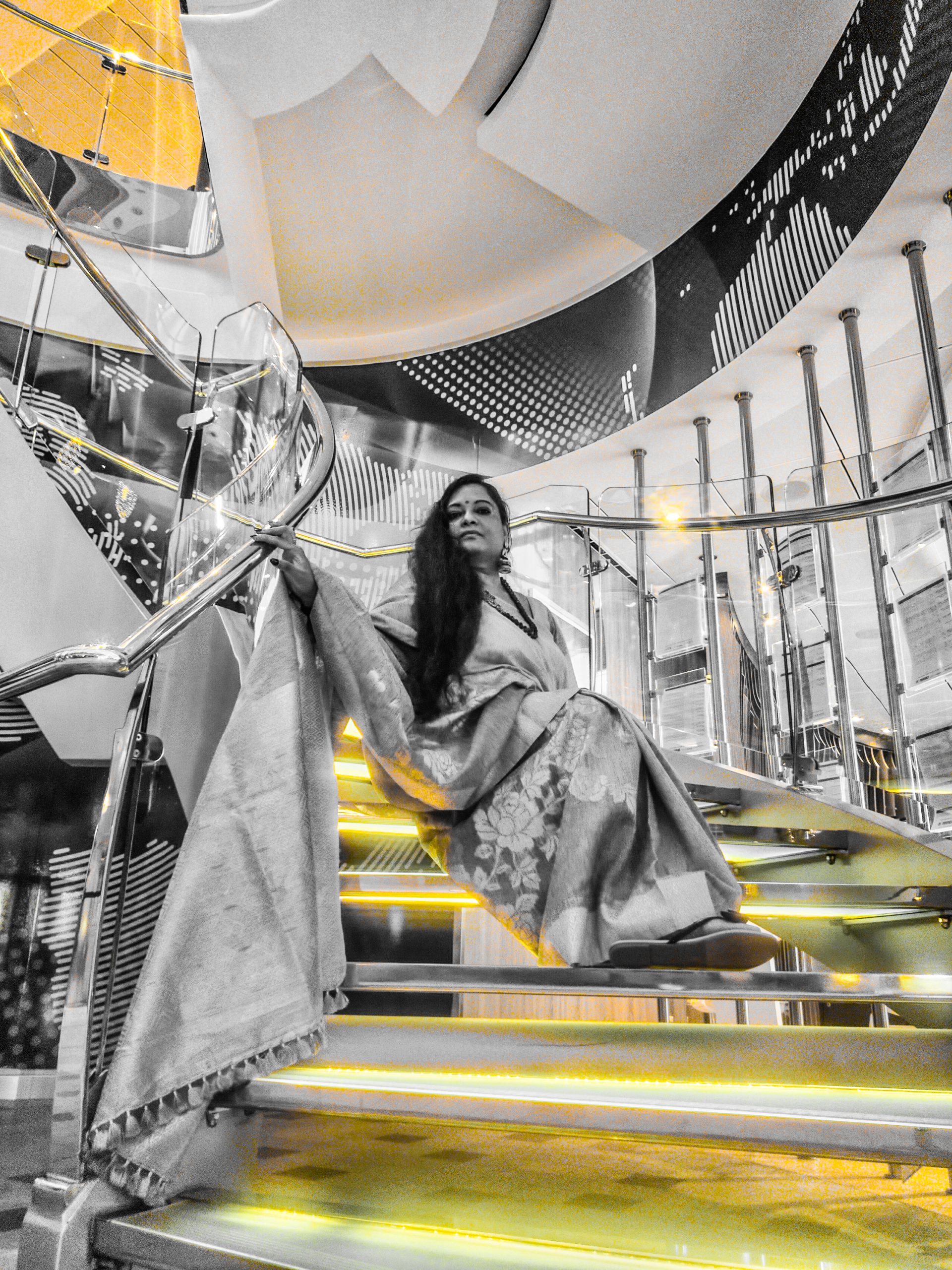
Life, as we all know, isn’t always a vibrant masterpiece. Sometimes, it feels like a stark, black and white photograph, devoid of the warmth and richness we crave. Worries creep in, shadows lengthen, and it’s easy to feel overwhelmed by the monochrome landscape of our challenges. But what if, instead of succumbing to the gray, we actively sought out the splashes of color that are always waiting to be discovered?
The Choice: Tears or Tint?
We’ve all been there – the weight of the world pressing down, the feeling that nothing is going right. In those moments, it’s tempting to let the tears flow, to dwell on the negativity, and to allow the black and white to consume us entirely. But here’s the thing: crying, while sometimes necessary, rarely solves the problem. It simply adds more shades of gray to an already dim picture. We don’t get angry at the rain when it falls, the summer heat when it scorches, or the winter cold when it chills. We understand these are natural occurrences, beyond our immediate control. So why do we so often get angry at ourselves or others for the inevitable challenges and imperfections of life? Instead, what if we chose to smile? What if we consciously decided to seek out the vibrant hues that can transform our perspective?
The Magic of a Smile
A smile is more than just a facial expression; it’s a powerful tool for shifting our mindset. It releases endorphins, those feel-good chemicals that boost our mood and reduce stress. It radiates positivity, not just to ourselves, but to everyone around us. A smile can be the spark that ignites a chain reaction of happiness.
Finding Your Colors
Finding your colors isn’t about ignoring the challenges; it’s about shifting your focus. It’s about recognizing the small joys that often go unnoticed:
Gratitude: Take a moment to appreciate the good things in your life, no matter how small. A warm cup of coffee, a kind word from a friend, a beautiful sunset – these are the colors that add depth to our experience.
Connection: Reach out to loved ones, share a laugh, offer a helping hand. Human connection is a powerful antidote to loneliness and despair. However, in today’s world, it’s essential to discern genuine connection from superficial interactions. Be discerning and don’t fall for the false or fake smile. Seek out authentic relationships where you feel seen, heard, and valued.
Creativity: Engage in activities that ignite your passion. Paint, write, play music, dance – express yourself and let your inner artist shine.
Mindfulness: Take a deep breath, slow down, and appreciate the present moment. Observe the beauty around you, the subtle nuances of life that often escape our notice.
Acts of Kindness: Helping others not only brings joy to them, but also to yourself.
Don’t Waste Time on Gray
Time is precious. Why waste it dwelling on negativity when you can actively create your own happiness? Choose to smile, choose to find your colors, and choose to live a life filled with joy.
Remember, even in the darkest of times, there is always a glimmer of light, a splash of color waiting to be discovered. So, smile, embrace the beauty around you, and paint your life with the vibrant hues of happiness. But remember to smile your life without hurting others around you. Create a beauty around you without hurting others around you, knowing or unknowing.