The Story of Pravision

Reimagining Success for Local & Scaling Businesses

Let’s face it: running a business today means paying a quiet, exhausting “app tax.” Most founders end up drowning in a sea of disconnected tools—switching between different software for their website, CRM, scheduling, bookkeeping, and marketing just to get through the morning.

Pravision was built to end that daily struggle, replacing software bloat with a clean, unified AI operating system that lets you focus on what actually matters.

2020–2021: The COVID Crisis & The Roots of Websiteistic

The story of Pravision started in 2020 when the COVID-19 pandemic hit. As lockdowns swept across California, local brick-and-mortar storefronts were forced to shut their doors overnight. Small business owners were left scrambling to figure out how to get online without clear guidance, technical skills, or huge budgets.

Seeing her community hurting, Praveena Jogi—a tech innovator with over 20 years of digital experience—decided to step in.

┌──────────────────────────────────────────────────────────────┐
│ PRAVEENA JOGI'S PHILOSOPHY │
│ │
│ "Deeply inspired by her father’s core value: │
│ 'Always the giving hand, not the taking hand.'" │
└──────────────────────────────────────────────────────────────┘

Driven by that spirit of giving back, Praveena founded Websiteistic in 2021. The mission was simple: provide local business owners with custom web development, clean branding, and solid SEO so they could survive the lockdowns and stay connected with their customers.

Rooted in Livermore, CA: From Wine Country & Culture to World-Class Tech

Pravision was born in Livermore, California, a unique city situated at the easternmost edge of the San Francisco Bay Area. Often recognized for its rich agricultural heritage, Livermore holds a distinctive place in California’s story:

  • 🍷 California’s Oldest Wine Region: Long before Silicon Valley became the tech capital of the world, the Livermore Valley was established in the 1840s as one of California’s premier wine-growing regions, home to historic vineyards like Wente and Concannon.

  • ⚛️ A Hub of Innovation & Science: Beyond its picturesque vineyards, Livermore is globally famous as a center of scientific discovery. It is home to the world-renowned Lawrence Livermore National Laboratory (LLNL)—where heavy chemical element Livermorium (Lv) was named in honor of the city—and Sandia National Laboratories.

  • 🛕 Spiritual & Cultural Heritage: Livermore is home to the Shiva-Vishnu Temple (Hindu Community and Cultural Center). Established in 1977, this architectural masterpiece features traditional South Indian-style gopurams and serves as a vibrant spiritual, educational, and community service hub for thousands of families across the Bay Area.

  • 💡 The Centennial Light Bulb: Demonstrating a spirit of lasting endurance, Livermore is home to the famous Centennial Light Bulb at Fire Station No. 6, which has been burning continuously since 1901—earning a place in the Guinness World Records as the longest-burning light bulb in history.

It was this exact blend of western community values, rich local heritage, and world-class technological innovation that inspired Praveena Jogi to launch Pravision right here in the Tri-Valley.

Living in a city that balances small-town community care with big-tech ambition reinforced Pravision’s core mission: bringing enterprise-grade AI operations to local business owners who deserve modern tools without Silicon Valley price tags.

The Evolution Timeline: From Local Agency to Unified System

As local businesses survived and started growing again, their tech needs got more complex. Praveena realized that entrepreneurs didn’t just need a website—they needed access to enterprise-grade tools on a small business budget to stay competitive.

2021: THE ROOTS
Websiteistic Founded 
└─ Helped local businesses navigate the pandemic with web design, branding, and local SEO.

2024: THE REBRAND
Pravision LLC
└─ Rebranded and expanded to bridge the gap between high-level enterprise tools and everyday small business budgets.

2025: MILESTONE & LAUNCH
CA Small Business (SB) Certification & The Pravision Console
└─ Earned official State of California certification and launched the proprietary AI-first platform, consolidating CRM, marketing, and back-office ops into one dashboard.

What Makes Pravision Different

Proudly based in Livermore, California, Pravision has evolved from a traditional marketing agency into an advanced AI business operating system for Tri-Valley companies and scaling businesses nationwide.

  • 🖥️ The Unified Pravision Console: Ditch software clutter by managing your website, calendar bookings, CRM, marketing automation, and local SEO in a single interface.

  • 📈 Modular “Pay-for-Growth” Model: Get free access to a core client portal for contracts, billing, and profile management, and only pay when you choose to unlock growth engines like sales and marketing automation.

  • 🔗 Easy Tool Connections: Connects smoothly with tools you already rely on, like Stripe, Google, and OpenPhone, to keep your contacts and data synced.

  • 👕 Turnkey Print & Merch Management: Skip the hassle of finding separate print vendors or managing orders yourself. Pravision completely takes care of designing, printing, and delivering custom t-shirts, backpacks, flyers, and pens right to your door.

  • 📲 Custom App Development: Outgrown standard tools? Pravision’s engineering team designs and builds custom web and mobile apps tailored to your specific operations.

The Heart Behind the Brand: Symbolism of the Orange Chakra

The Pravision logo features a vibrant orange chakra. Inspired by the sacred Sudarshana Chakra of Lord Sri Venkateswara (Maha Vishnu)—the celestial disc that protects the righteous, cuts through obstacles, and restores order—the emblem carries deep personal and symbolic meaning:

  • Energy & Divine Guidance: The vibrant orange hue symbolizes creative energy, passion, and continuous motion.

  • 🛡️ Protection & Clarity of Purpose: Just as the Sudarshana Chakra represents divine protection and cosmic clarity, Pravision stands as an operational shield for entrepreneurs—cutting through administrative chaos and software obstacles so businesses can thrive.

  • 🔄 Dynamic Growth & Perfection: The circular wheel represents the ongoing pursuit of perfection, innovation, and unstoppable momentum in an ever-evolving digital world.

Recognized by Marquis Who’s Who for standout leadership in technology and sales transformation, Praveena Jogi leads Pravision as CEO & Lead Architect—helping entrepreneurs reclaim their time, strip away software clutter, and build lasting success.

The Hidden “App Tax” Sucking the Time Out of Your Tutoring Business

If you run a tutoring business, your day probably looks something like this:

You check your email on one tab, open Calendly to fix a scheduling conflict between a tutor and a student, log into separate accounting software to check an invoice, switch to VistaPrint to reorder branded pens, and open a spreadsheet to check on a new student inquiry.

By 10:00 AM, you haven’t taught a single student—you’ve just paid the “App Tax.” You’re paying hundreds of dollars a month for multiple software subscriptions that force you to play administrative manager instead of educator.

Whether you run a single local center or manage a network of online tutors nationwide, Pravision was built to eliminate that chaos. Pravision isn’t a collection of third-party integrations taped together—everything is built directly into our unified system out of the box.

  • A Professional Front Door That Enrolls Students: We build custom, high-converting websites directly on the platform. Your site builds instant trust with parents and guides them seamlessly toward booking their first session.

  • Built-in CRM & Bookkeeping: Manage student leads, parent contacts, session notes, billing, and full bookkeeping natively inside Pravision. No separate accounting software, no external CRM subscriptions, and no messy spreadsheets.

  • Built-in Multi-Calendar Scheduling (Ditch Calendly): Stop paying extra monthly fees for standalone booking apps like Calendly. Pravision comes with native scheduling built right in. Connect every tutor’s calendar in real time, let parents book open slots in seconds, and check availability across your entire team automatically.

  • Built-in Print & Merch Operations: Need t-shirts for your staff, branded backpacks for your students, or flyers for local schools? Skip the hassle of finding a local printer or navigating online vendors. Pravision designs, prints, and delivers pens, notebooks, apparel, and marketing materials straight to your door.

  • Custom App Development on Demand: Outgrown standard tools? If you need a fully custom student portal, an interactive learning tool, or a proprietary mobile app tailored to your exact curriculum, Pravision can build and deploy custom software from scratch.

Focus on the Next Generation You didn’t start a tutoring business to juggle software subscriptions and third-party tools. You started it to help students unlock their potential and build confidence.

Pravision handles the tech, operations, and logistics inside a unified system so you can get back to what actually matters: shaping the future.

How to Write a Resume That Gets Interviews in 2026

Flat lay graphic with resume icons, text overlay reading "how to write a resume that gets interviews in 2024"

Learning how to write a resume that gets interviews in 2026 is more critical than ever in today’s competitive job market. With artificial intelligence screening systems, evolving recruiter expectations, and new digital hiring platforms, your resume needs to be strategically crafted to stand out. This comprehensive guide will walk you through every step of creating a resume that not only passes automated screening but compels hiring managers to schedule that crucial interview.

Understanding Modern Resume Requirements in 2026

The landscape of resume writing has transformed dramatically. Today’s resumes must satisfy both AI-powered Applicant Tracking Systems (ATS) and human recruiters. According to current hiring trends, over 95% of Fortune 500 companies now use advanced ATS software with machine learning capabilities that go beyond simple keyword matching.

Your resume must be designed with a dual purpose: machine readability and human appeal. This means incorporating relevant keywords naturally while maintaining compelling storytelling that showcases your unique value proposition. The most successful resumes in 2026 balance technical optimization with authentic personal branding.

The Role of AI in Resume Screening

Modern ATS systems use natural language processing and semantic analysis to evaluate resumes. These systems don’t just look for exact keyword matches—they understand context, assess skill relevance, and even predict candidate success based on historical hiring data. Your resume should incorporate industry-specific terminology while demonstrating concrete achievements that AI algorithms can quantify and rank.

Essential Components of an Interview-Winning Resume

To write a resume that gets interviews in 2026, you must include these critical elements structured in a way that maximizes both ATS compatibility and recruiter engagement.

Strategic Contact Information and Header

Start with a clean, professional header containing your full name, phone number, professional email address, LinkedIn profile URL, and optionally your portfolio website or relevant social media profiles. Avoid graphics, logos, or unusual formatting in this section as they can confuse ATS systems.

Compelling Professional Summary

Replace outdated objective statements with a powerful professional summary of 3-4 sentences. This section should immediately communicate your value proposition, years of experience, key expertise areas, and most impressive achievement. Use dynamic action words and quantifiable metrics whenever possible.

Skills Section Optimized for ATS

Create a dedicated skills section that includes both hard and soft skills relevant to your target position. Include:

  • Technical skills and software proficiencies
  • Industry-specific certifications and qualifications
  • Relevant soft skills like leadership, communication, and problem-solving
  • Emerging skills like AI tools, data analytics, or automation platforms

List these skills using the exact terminology found in job descriptions to ensure ATS recognition.

Results-Driven Work Experience

This is the most critical section of your resume. For each position, include your job title, company name, location, and dates of employment. Follow with 3-5 bullet points that emphasize achievements rather than responsibilities. Use the CAR method (Challenge-Action-Result) to structure your accomplishments:

  • Challenge: Briefly describe the problem or situation
  • Action: Explain what you specifically did
  • Result: Quantify the outcome with metrics, percentages, or dollar amounts

For example: “Redesigned customer onboarding process (Challenge), implementing automated workflows and personalized touchpoints (Action), resulting in 47% reduction in churn and $2.3M additional annual revenue (Result).”

Education and Certifications

List your educational background in reverse chronological order, including degree type, major, institution name, and graduation year. If you’re a recent graduate, you can include relevant coursework, academic honors, or significant projects. For experienced professionals, keep this section concise and move it toward the end of your resume.

Formatting Best Practices for Maximum Impact

How you format your resume is just as important as what you include. In 2026, certain formatting principles are essential for ensuring both ATS compatibility and visual appeal.

Choose the Right Resume Format

The reverse-chronological format remains the most effective and ATS-friendly option. It lists your work experience starting with your most recent position and working backward. This format works for most job seekers and is preferred by 90% of recruiters.

Functional or skills-based formats should be avoided unless you’re making a significant career change, as ATS systems often struggle to parse them correctly.

Typography and Visual Design

Use standard, professional fonts like Arial, Calibri, Georgia, or Garamond in 10-12 point size. Maintain consistent formatting throughout with clear section headers in bold or slightly larger font. Use adequate white space to improve readability—margins should be 0.5 to 1 inch on all sides.

Avoid tables, text boxes, headers, footers, columns, and graphics that can confuse ATS parsing algorithms. Stick to standard bullet points and simple formatting.

Optimal Resume Length

For most professionals, a one-page resume is ideal if you have less than 10 years of experience. Two pages are acceptable for senior-level positions or extensive relevant experience. Never exceed two pages unless you’re in academia or a field where comprehensive publication lists are expected.

Advanced Strategies to Optimize Your Resume for Interviews

Beyond the basics, these advanced techniques will significantly increase your chances of landing interviews.

Keyword Optimization Without Stuffing

Analyze 5-10 job descriptions for your target role and identify recurring keywords and phrases. Incorporate these naturally throughout your resume, particularly in your skills section and work experience bullet points. Focus on role-specific terminology, required qualifications, and industry jargon that demonstrates your expertise.

However, avoid keyword stuffing—modern AI can detect this and may flag your resume as spam. Every keyword should appear in meaningful context that demonstrates actual experience or capability.

Quantify Everything Possible

Numbers catch both ATS algorithms and human eyes. Wherever possible, include specific metrics:

  • Revenue generated or costs saved (dollar amounts)
  • Percentage improvements or growth rates
  • Team sizes you’ve managed
  • Number of clients, projects, or accounts handled
  • Timeframes that demonstrate efficiency

Even if your role isn’t traditionally metrics-driven, find ways to quantify impact. Instead of “Managed social media accounts,” write “Grew social media following by 340% across 4 platforms, driving 12,000+ monthly website visits.”

Tailor Each Resume to the Specific Job

Generic resumes get generic results. The most successful approach to writing a resume that gets interviews in 2026 is customization. Create a master resume with all your experiences and achievements, then create targeted versions for each application by:

  • Adjusting your professional summary to match the role
  • Reordering skills to prioritize those mentioned in the job description
  • Emphasizing relevant experiences and accomplishments
  • Using the company’s language and terminology

This targeted approach may take more time, but it dramatically increases your interview rate.

Include Modern Competencies

In 2026, certain skills and experiences signal that you’re a forward-thinking professional. When relevant, highlight your experience with:

  • AI tools and automation platforms
  • Remote collaboration and digital workspace tools
  • Data analysis and visualization
  • Sustainability initiatives or ESG considerations
  • Diversity, equity, and inclusion efforts
  • Agile methodologies and adaptive project management

Common Resume Mistakes That Kill Your Interview Chances

Avoid these critical errors that immediately disqualify candidates:

Spelling and Grammar Errors: Even minor typos signal carelessness. Use spell-check, grammar tools, and have multiple people proofread your resume before submitting.

Unprofessional Email Addresses: Create a professional email address using your name. Addresses like “partyguy123@email.com” will get your resume rejected immediately.

Irrelevant Information: Leave out personal details like age, marital status, photo (unless specifically requested), or hobbies unless directly relevant to the position.

Employment Gaps Without Explanation: If you have significant gaps, address them briefly and positively. Focus on any skills developed, consulting work, or professional development during those periods.

Passive Language: Replace weak phrases like “responsible for” or “duties included” with strong action verbs like “spearheaded,” “optimized,” “launched,” or “transformed.”

Outdated or Irrelevant Experience: Focus on the last 10-15 years of relevant experience. You can summarize earlier career history briefly or omit it entirely if it doesn’t add value.

Testing and Refining Your Resume

Before submitting your resume, take these steps to ensure it’s optimized:

Use online ATS checkers and resume scanners to identify potential parsing issues. Many free tools can show you how an ATS reads your resume and highlight areas for improvement.

Save your resume as both a .docx and PDF file. While PDFs preserve formatting, some older ATS systems prefer Word documents. Check the application instructions for guidance.

Test different versions by tracking which resume variations lead to more interview requests. Keep notes on what works and continuously refine your approach.

Get feedback from professionals in your industry, career coaches, or trusted colleagues who can provide objective insights on how your resume presents your qualifications.

Frequently Asked Questions

How long should my resume be in 2026?

For most professionals, one page is ideal for up to 10 years of experience. Two pages are appropriate for senior roles or extensive relevant experience. Focus on quality over quantity—every line should add value. Never exceed two pages unless you’re in a field like academia where comprehensive listings are expected.

Should I include a photo on my resume?

In most countries including the United States, do not include a photo on your resume. Photos can introduce bias and many companies remove them to ensure fair evaluation. Only include a photo if it’s specifically requested or customary in your country or industry. Focus instead on compelling content that demonstrates your qualifications.

How do I optimize my resume for ATS systems?

To optimize for ATS: use a simple, clean format without graphics or tables; include relevant keywords from the job description naturally throughout your resume; use standard section headings like “Work Experience” and “Education”; save in .docx or PDF format as specified; avoid headers, footers, and text boxes; and use standard fonts. Most importantly, tailor your resume to each specific job application.

What’s the difference between a resume and a CV in 2026?

A resume is a concise 1-2 page document highlighting your most relevant skills and experiences for a specific job. A CV (curriculum vitae) is a comprehensive document that includes your entire academic and professional history, publications, presentations, and research. In the US, resumes are used for most jobs while CVs are primarily for academic, research, or medical positions. In many other countries, the terms are used interchangeably.

How often should I update my resume?

Update your resume at least every 3-6 months, even when not actively job searching. Add new accomplishments, skills, certifications, and quantifiable results as you achieve them. This makes it easier to recall specific details and ensures you’re always ready for unexpected opportunities. Keep a running document of achievements so you never forget important accomplishments when it’s time to apply for positions.

Best AI Video Analytics Software for Business Security 2026

Pravisión logo with orange mandala design surrounded by AI, security, and analytics icons on digital circuit background.

Finding the best AI video analytics software for business security has become essential for organizations looking to protect their assets, employees, and customers in 2026. As security threats evolve and surveillance technology advances, businesses need intelligent solutions that go beyond traditional video monitoring to provide real-time insights, predictive alerts, and automated threat detection.

Modern AI-powered video analytics platforms transform passive security cameras into proactive defense systems, leveraging computer vision, deep learning, and advanced algorithms to detect anomalies, recognize patterns, and alert security teams before incidents escalate. This comprehensive guide explores the leading solutions available today and helps you choose the right platform for your business needs.

What Is AI Video Analytics Software?

AI video analytics software uses artificial intelligence and machine learning algorithms to automatically analyze video footage in real-time or retrospectively. Unlike traditional surveillance systems that simply record footage for later review, these intelligent platforms actively monitor, interpret, and respond to events as they occur.

The technology employs computer vision to identify objects, people, vehicles, and behaviors within video streams. Advanced neural networks enable these systems to distinguish between normal activity and potential security threats, reducing false alarms while ensuring genuine incidents receive immediate attention.

Key capabilities of modern AI video analytics include facial recognition, license plate reading, crowd detection, perimeter intrusion alerts, abandoned object identification, and behavioral analysis. These features work together to create a comprehensive security ecosystem that protects businesses more effectively than ever before.

Top Features to Look for in AI Video Analytics Software

When evaluating the best AI video analytics software for business security, certain features separate exceptional solutions from basic offerings. Understanding these capabilities helps you make an informed decision that aligns with your security requirements and budget.

Real-Time Threat Detection and Alerts

The most valuable AI video analytics platforms provide instant notifications when suspicious activities occur. Look for solutions that offer customizable alert parameters, allowing you to define what constitutes a threat for your specific environment. Advanced systems use predictive analytics to identify potential security breaches before they happen, giving your team precious time to respond.

Object and Facial Recognition

Sophisticated recognition capabilities enable your security system to identify specific individuals, vehicles, or objects across multiple camera feeds. This feature proves invaluable for access control, tracking unauthorized personnel, and creating watchlists of persons of interest. The best platforms achieve recognition accuracy rates exceeding 98% even in challenging lighting conditions.

Behavioral Analysis and Pattern Recognition

Advanced AI algorithms can learn normal behavioral patterns within your facility and flag deviations that might indicate security risks. Whether it’s detecting loitering near restricted areas, identifying unusual traffic patterns, or recognizing aggressive behaviors, these intelligent systems provide context-aware security monitoring.

Integration Capabilities

Your AI video analytics software should seamlessly integrate with existing security infrastructure, including access control systems, alarm panels, and emergency response protocols. Cloud-based platforms offer particular advantages for multi-site businesses, enabling centralized monitoring and management across all locations.

Leading AI Video Analytics Platforms for Business Security in 2026

The market for AI-powered security solutions has matured significantly, with several platforms emerging as industry leaders. Here are the top contenders offering the best AI video analytics software for business security this year.

Enterprise-Grade Solutions

Verkada Command: This cloud-managed platform combines cameras, software, and AI analytics in a unified ecosystem. Verkada excels in scalability, making it ideal for businesses with multiple locations. The system offers unlimited cloud archiving, person of interest alerts, and powerful search capabilities that let you find specific people or vehicles across your entire camera network within seconds.

Avigilon Unity: Known for exceptional video quality and advanced analytics, Avigilon Unity provides comprehensive security intelligence with focus-of-attention technology that highlights unusual motion in crowded scenes. The platform’s appearance search feature enables security teams to quickly locate individuals based on clothing color, gender, and other physical characteristics.

Genetec Security Center: This open-architecture platform unifies video surveillance, access control, and license plate recognition in a single interface. Genetec’s AI-powered analytics include people counting, heat mapping, and retail-specific features like queue management and occupancy monitoring.

Mid-Market and Scalable Options

Eagle Eye Networks: This cloud-based solution offers flexible deployment options and robust AI analytics at competitive pricing. Eagle Eye’s platform includes advanced search, motion detection, and integration with third-party analytics applications, making it suitable for growing businesses.

Rhombus: Designed for ease of use, Rhombus provides plug-and-play cameras with built-in AI analytics and unlimited cloud storage. The platform’s intuitive interface and automatic software updates make it attractive for businesses without dedicated IT security teams.

DeepAlert AI: Specializing in behavioral analytics, DeepAlert uses deep learning to identify complex security scenarios including slip-and-fall incidents, workplace violence indicators, and unauthorized area access. The system’s low false-alarm rate makes it particularly valuable for businesses seeking to reduce security team fatigue.

Implementation Considerations and Best Practices

Selecting the best AI video analytics software for business security represents only the first step. Successful implementation requires careful planning and adherence to proven practices that maximize your investment’s value.

Assessing Your Security Requirements

Begin by conducting a comprehensive security audit that identifies your facility’s vulnerabilities, high-risk areas, and specific threats. Different industries face distinct challenges—retail environments prioritize theft prevention and customer safety, while manufacturing facilities focus on perimeter security and workplace safety compliance. Understanding your unique needs ensures you select a platform with the right feature set.

Camera Placement and Coverage

AI analytics perform only as well as the video quality they receive. Strategic camera placement ensures optimal coverage of critical areas while minimizing blind spots. Consider lighting conditions, camera angles, and resolution requirements for effective facial recognition and object detection. Most experts recommend minimum 4MP resolution for reliable AI analytics performance.

Privacy and Compliance

In 2026, data privacy regulations continue evolving globally. Your chosen platform must comply with GDPR, CCPA, and industry-specific requirements relevant to your business. Look for solutions offering privacy masking, data encryption, and configurable retention policies. Transparent data handling practices protect your organization from legal liability while maintaining stakeholder trust.

Training and Change Management

Even the most sophisticated AI video analytics software requires proper training for security personnel. Invest in comprehensive onboarding that covers system operation, alert response protocols, and troubleshooting procedures. Establish clear policies governing system use, investigation procedures, and evidence handling to ensure consistent, effective security operations.

ROI and Cost Considerations

Understanding the financial implications of AI video analytics helps justify your investment and set realistic expectations for returns. While premium platforms command higher upfront costs, they often deliver superior long-term value through reduced security incidents, lower insurance premiums, and operational efficiencies.

Typical pricing models include per-camera licensing fees ranging from $200 to $800 annually for cloud-based solutions, or perpetual licenses with maintenance contracts for on-premises deployments. Enterprise platforms may charge based on the number of monitored locations or concurrent users rather than individual cameras.

Calculate total cost of ownership by including hardware expenses, installation costs, training investment, and ongoing subscription or maintenance fees. Many businesses recoup their investment within 18-24 months through prevented losses, reduced security staffing requirements, and insurance premium reductions.

Beyond direct cost savings, AI video analytics provides valuable business intelligence. Retail operations use heat mapping and traffic analysis to optimize store layouts. Manufacturing facilities leverage safety analytics to reduce workplace injuries and associated costs. These secondary benefits often exceed the primary security value.

Future Trends in AI Video Analytics

The AI video analytics landscape continues evolving rapidly as technology advances. Understanding emerging trends helps you select a platform that remains relevant as capabilities expand.

Edge computing integration represents a significant development, with more AI processing occurring directly on cameras rather than in the cloud or central servers. This architecture reduces bandwidth requirements, improves response times, and enhances privacy by minimizing data transmission.

Multi-modal analytics combining video with audio, thermal imaging, and IoT sensor data creates more comprehensive security intelligence. These integrated systems provide contextual awareness that single-source analytics cannot match.

Predictive analytics powered by machine learning models trained on historical incident data will increasingly anticipate security threats before they materialize. This proactive approach represents the next frontier in business security, shifting from reactive response to preventive intervention.

Ethical AI and bias mitigation have become central concerns, with leading vendors investing heavily in fairness testing and algorithm transparency. Businesses should prioritize solutions from vendors demonstrating commitment to responsible AI development and deployment.

Frequently Asked Questions

What is the difference between traditional video surveillance and AI video analytics?

Traditional video surveillance systems passively record footage for later review by human operators, while AI video analytics actively monitors streams in real-time, automatically detecting threats, recognizing patterns, and generating intelligent alerts. AI-powered systems significantly reduce the burden on security staff by filtering out irrelevant events and highlighting genuine security concerns, making them far more effective for modern business security needs.

How accurate is AI video analytics software in detecting security threats?

The best AI video analytics software for business security in 2026 achieves accuracy rates exceeding 95-98% for object detection and facial recognition under optimal conditions. Accuracy depends on factors including video quality, lighting, camera angles, and the specific algorithms employed. Advanced platforms use continuous learning to improve detection accuracy over time, while customizable sensitivity settings help balance between capturing all potential threats and minimizing false alarms.

Can AI video analytics integrate with my existing security cameras?

Many modern AI video analytics platforms support integration with existing IP cameras through standard protocols like ONVIF and RTSP. However, optimal performance typically requires cameras meeting minimum specifications for resolution (usually 4MP or higher), frame rate, and processing capability. Some advanced features like edge analytics require compatible hardware. Cloud-based analytics platforms offer the most flexibility for existing camera integration, though upgrading older analog systems to IP cameras may be necessary.

What are the privacy implications of using AI video analytics for business security?

AI video analytics platforms must comply with data protection regulations including GDPR, CCPA, and industry-specific requirements. Reputable solutions offer privacy features such as automatic face blurring, configurable data retention periods, encrypted storage, and detailed access logs. Businesses should implement clear policies governing system use, ensure transparency with employees and visitors about surveillance practices, and limit data collection to legitimate security purposes. Working with vendors who prioritize privacy by design helps mitigate legal and ethical risks.

How much does AI video analytics software cost for a typical business?

Pricing varies significantly based on the number of cameras, deployment model (cloud vs. on-premises), and feature requirements. Cloud-based solutions typically charge $200-$800 per camera annually, while enterprise platforms may use site-based or user-based licensing. A small business with 10-20 cameras might expect annual costs of $3,000-$8,000, while mid-sized operations with 50-100 cameras could invest $15,000-$40,000 yearly. Enterprise deployments across multiple locations often negotiate custom pricing. Remember to factor in hardware costs, installation, training, and ongoing support when calculating total investment.


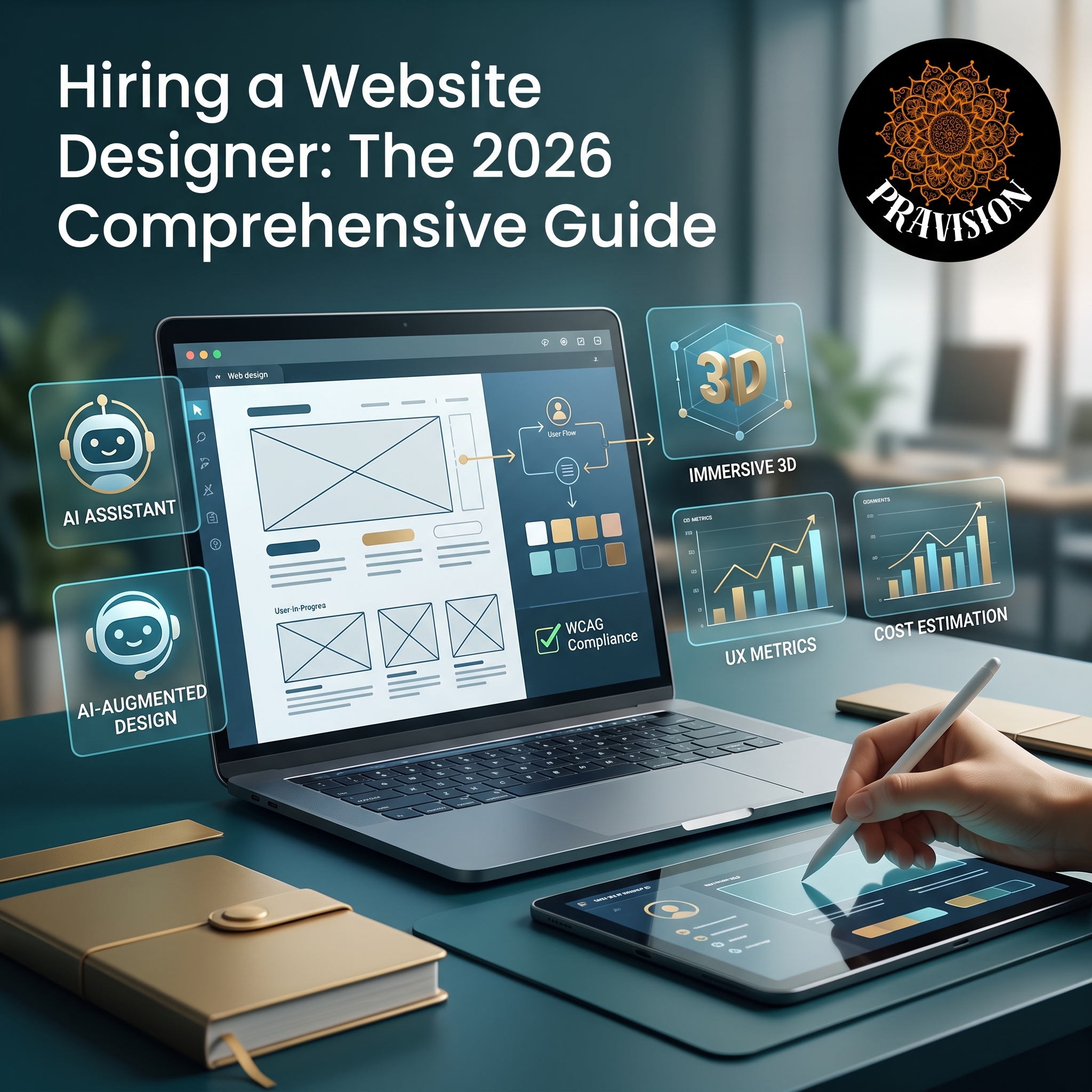
Hiring a Website Designer

Laptop displaying website design wireframes with AI assistant and augmented design tools, alongside tablet showing 3D immersive, UX metrics, and cost estimation features; Pravision logo in top right corner.

Finding the right website designer can be the difference between a digital presence that drives growth and one that falls flat. Whether you’re launching a startup, rebranding an established business, or simply need a website refresh, understanding what makes an exceptional website designer and how to work with one is crucial for success in 2026’s competitive digital landscape.

This comprehensive guide will walk you through everything you need to know about hiring a website designer, from understanding their role and evaluating their skills to managing costs and ensuring a successful collaboration.

What Does a Website Designer Do in 2026?

A website designer is a professional who creates the visual layout, user interface, and overall aesthetic of websites. Unlike web developers who focus on coding and functionality, designers concentrate on the look, feel, and user experience of your digital presence.

In 2026, the role of a website designer has evolved significantly with the integration of AI-assisted design tools, advanced prototyping software, and a deeper understanding of neurodesign principles. Modern website designers typically handle:

  • Visual design: Creating color schemes, typography, imagery, and overall brand consistency
  • User experience (UX): Designing intuitive navigation and user flows that guide visitors toward conversion
  • Responsive design: Ensuring websites function perfectly across all devices, from smartphones to large desktop displays
  • Accessibility compliance: Making websites usable for people with disabilities, meeting WCAG standards
  • AI integration: Incorporating intelligent chatbots, personalization features, and dynamic content
  • Performance optimization: Designing with page speed and Core Web Vitals in mind

The best website designers combine artistic creativity with strategic thinking, understanding that beautiful design must also drive business results.

Types of Website Designers: Finding Your Perfect Match

Not all website designers specialize in the same areas. Understanding the different types can help you find the right fit for your project.

Freelance Website Designers

Independent designers offer flexibility and often more affordable rates. They’re ideal for small to medium-sized projects and businesses that want direct communication with their designer. Freelance website designers typically have diverse portfolios spanning multiple industries and can provide personalized attention to your project.

Website Design Agencies

Agencies provide comprehensive services with teams of specialists including designers, developers, strategists, and project managers. They’re best suited for complex projects requiring multiple skill sets, ongoing support, or enterprise-level solutions. While more expensive, agencies offer accountability and broader expertise.

In-House Website Designers

For companies with continuous design needs, hiring a full-time website designer makes sense. This option provides deep brand knowledge and immediate availability but requires a significant financial commitment and may lack the diverse perspective outside designers bring.

Specialized vs. Generalist Designers

Some designers specialize in specific industries (e-commerce, healthcare, finance) or design types (minimalist, interactive, immersive). Specialists bring deep domain knowledge, while generalists offer versatility. Consider your project’s unique requirements when choosing.

How to Evaluate a Website Designer: Key Criteria

Choosing the right website designer requires careful evaluation. Here are the essential factors to consider:

Portfolio Quality and Relevance

Review their previous work for aesthetic appeal, functionality, and diversity. Look for projects similar to yours in scope and industry. Pay attention to mobile responsiveness, loading speeds, and how designs have aged over time. In 2026, also examine how well they’ve integrated emerging technologies like AI personalization and immersive experiences.

Technical Proficiency

Today’s website designers should be proficient in industry-standard tools including Figma, Adobe XD, Sketch, and AI-powered design assistants. They should understand design systems, component libraries, and how their designs translate to code. Ask about their familiarity with popular content management systems like WordPress, Webflow, or Shopify.

Communication and Collaboration Skills

Great designers listen actively, ask probing questions, and can explain design decisions in business terms. They should be comfortable receiving feedback and iterating on designs. During initial conversations, assess their responsiveness and whether they understand your business goals beyond just aesthetics.

Understanding of User Experience Principles

The most visually stunning website fails if users can’t navigate it effectively. Your website designer should demonstrate knowledge of UX research, user testing methodologies, conversion optimization, and accessibility standards. Ask how they approach user journey mapping and what metrics they use to measure design success.

Timeline and Process Transparency

Professional designers follow structured processes with clear milestones, deliverables, and revision policies. They should provide realistic timelines and communicate proactively about any potential delays. Understand their design process from discovery through delivery and ongoing support.

Website Designer Costs: What to Expect in 2026

Pricing for website design services varies dramatically based on complexity, designer experience, and project scope. Understanding current market rates helps you budget appropriately and avoid both overpriced and suspiciously cheap options.

Freelance Designer Rates

Freelance website designers typically charge between $50-$200 per hour, with experienced specialists commanding premium rates. Project-based pricing for small business websites ranges from $2,000-$10,000, while more complex sites can cost $10,000-$50,000+. Entry-level designers may offer lower rates but require more guidance and revisions.

Agency Pricing

Design agencies generally charge $100-$300+ per hour, with comprehensive website projects starting around $10,000 and scaling to $100,000+ for enterprise solutions. Agencies include strategy, multiple rounds of revisions, and often provide ongoing support packages.

Factors Affecting Cost

Several elements influence final pricing: website complexity and number of pages, custom illustrations or photography requirements, e-commerce functionality, third-party integrations, SEO optimization, content creation, and post-launch support. AI-powered personalization features and advanced interactive elements also add to costs.

Hidden Costs to Consider

Beyond the initial design fee, budget for domain registration, hosting services, premium plugins or themes, stock imagery licenses, ongoing maintenance, and future updates. Clarify what’s included in the quoted price to avoid surprises.

Working Successfully with Your Website Designer

The designer-client relationship significantly impacts project outcomes. Follow these best practices for optimal collaboration:

Prepare a comprehensive brief: Before engaging a website designer, document your business goals, target audience, competitor examples, brand guidelines, preferred and disliked styles, required features, and budget constraints. Clear direction upfront prevents misalignment later.

Establish clear communication channels: Agree on preferred communication methods, response time expectations, and regular check-in schedules. Use project management tools to centralize feedback and track progress.

Provide constructive feedback: When reviewing designs, explain the reasoning behind requested changes rather than just stating preferences. Frame feedback around user needs and business objectives rather than personal taste.

Trust their expertise: You hired a professional for their skills and experience. While your input is valuable, remain open to their recommendations, especially regarding user experience and current design best practices.

Plan for iterations: Rarely is the first design concept perfect. Budget time and resources for revisions, understanding that refinement is part of the creative process.

Red Flags: Warning Signs to Avoid

Not every website designer delivers quality results. Watch for these warning signs:

  • Portfolios filled with template-based designs with minimal customization
  • Inability to explain design decisions or discuss UX principles
  • Reluctance to provide references or case studies
  • Unrealistically low prices that seem too good to be true
  • Poor communication or delayed responses during the sales process
  • No formal contract or vague project scope documentation
  • Pressure to start immediately without proper discovery
  • Ownership rights issues regarding final design files

Trust your instincts—if something feels off during initial interactions, it likely won’t improve during the project.

The Future of Website Design: Trends Shaping 2026

Understanding current trends helps you evaluate whether a website designer stays current with industry evolution:

AI-augmented design: Leading designers leverage AI tools for rapid prototyping, automated accessibility testing, and data-driven design decisions while maintaining creative control.

Immersive 3D experiences: WebGL and WebGPU technologies enable sophisticated 3D elements without sacrificing performance, creating more engaging user experiences.

Hyper-personalization: Websites now dynamically adapt content, layouts, and calls-to-action based on user behavior, preferences, and context.

Sustainability-focused design: Energy-efficient websites with optimized assets and code are increasingly important as environmental consciousness grows.

Voice and gesture interfaces: Forward-thinking designers consider multi-modal interactions beyond traditional clicking and scrolling.

Frequently Asked Questions About Website Designers

How long does it take a website designer to complete a project?

Timeline varies based on project complexity. Simple small business websites typically require 4-6 weeks, while comprehensive e-commerce sites or custom web applications may take 3-6 months. Factors affecting duration include revision rounds, content availability, stakeholder approval processes, and designer workload. Discuss realistic timelines during initial consultations and build in buffer time for unexpected delays.

What’s the difference between a website designer and a web developer?

A website designer focuses on visual aesthetics, user interface, and user experience—essentially how the website looks and feels. Web developers handle the technical implementation, writing code to bring designs to life and ensure functionality. Many professionals offer both services, while others specialize in one area. For complex projects, you may need both a designer for creative aspects and a developer for technical execution.

Should I hire a local website designer or work remotely?

Both approaches have merits. Local designers enable face-to-face meetings and may better understand regional market nuances, but limit your talent pool. Remote collaboration, now standard in 2026, opens access to global talent, often at competitive rates, with video conferencing tools making distance irrelevant. Prioritize skill fit over geography, though consider time zone differences for communication purposes.

Do I own the website design after paying for it?

Ownership should be clearly outlined in your contract. Most professional agreements transfer design ownership to clients upon final payment, including source files and assets. However, designers may retain portfolio rights to showcase the work. Clarify intellectual property terms before starting, ensuring you receive all files needed for future updates or platform migrations.

How much input should I provide during the design process?

Balance is key. Provide comprehensive information upfront about your business, audience, and goals, then allow your website designer creative freedom within those parameters. Offer feedback at designated milestones rather than constant micromanagement. Your designer brings expertise in visual communication and user experience, so trust their recommendations while ensuring the final product aligns with your strategic objectives.


Related Articles

Pravision: Complete Guide to Vision Planning in 2026

Ornate steampunk compass wheel with "Prevision" center, surrounded by six business strategy icons including tree heads, gears, graphs, and world map showing global connections.

In today’s rapidly evolving business landscape, Pravision LLC has emerged as a critical partner for organizations seeking to maintain a competitive advantage through proactive vision planning. Pravision combines strategic foresight with practical implementation frameworks, enabling businesses to anticipate changes and position themselves ahead of market shifts. Based in Livermore, CA, this certified State of California Small Business (SB) offers a comprehensive framework that explores everything you need to know about Pravision and how to leverage it effectively in 2026.

Pravision is the strategic practice of developing and implementing forward-looking vision statements that guide organizational decision-making and resource allocation. Unlike traditional vision planning that focuses primarily on aspirational goals, Pravision emphasizes actionable pathways and measurable outcomes that bridge the gap between current reality and future objectives.

The term itself combines “proactive” and “vision,” reflecting its core principle: organizations must actively shape their future rather than simply reacting to changes as they occur. In an era where technological disruption, market volatility, and shifting consumer preferences have become the norm, Pravision provides a structured approach to navigating uncertainty.

Key characteristics of effective Pravision include:

  • Data-driven forecasting based on market trends and analytics

  • Flexible frameworks that adapt to changing circumstances

  • Clear alignment between vision statements and operational strategies

  • Regular review cycles to ensure relevance and effectiveness

  • Stakeholder engagement throughout the planning process

The Core Components of the Pravision Framework

Implementing Pravision successfully requires understanding its fundamental components. These elements work together to create a comprehensive approach to strategic vision development.

Environmental Scanning and Analysis The foundation of any Pravision initiative begins with thorough environmental scanning. This involves systematically monitoring external factors that could impact your organization, including technological advancements, regulatory changes, competitive movements, and socioeconomic trends. In 2026, artificial intelligence and predictive analytics tools have made this process more sophisticated and accurate than ever before.

Scenario Planning and Modeling Scenario planning allows organizations to explore multiple possible futures and develop contingency strategies for each. Rather than committing to a single predicted outcome, Pravision embraces uncertainty by preparing for various scenarios. This approach ensures resilience and adaptability regardless of which future materializes.

Vision Articulation and Communication A clearly articulated vision serves as the north star for all organizational activities. Pravision demands that this vision be communicated consistently across all levels of the organization, ensuring that every team member understands their role in achieving shared objectives. The most effective visions are memorable, inspiring, and specific enough to guide decision-making.

Implementation Roadmapping The transition from vision to reality requires detailed roadmapping that outlines specific initiatives, timelines, resource requirements, and success metrics. Pravision emphasizes creating realistic, phased implementation plans that allow for course corrections as circumstances evolve.

Benefits of Adopting Pravision in Your Organization

Organizations that embrace Pravision principles consistently outperform their competitors in key performance indicators. Research conducted throughout 2026 has identified several concrete benefits associated with proactive vision planning.

  • Enhanced Strategic Agility: Companies practicing Pravision demonstrate superior ability to pivot quickly when market conditions change. By anticipating multiple scenarios and preparing appropriate responses, these organizations reduce response time and minimize disruption during transitions.

  • Improved Resource Allocation: When strategic vision clearly connects to operational planning, resources flow more efficiently to high-impact initiatives. Pravision helps eliminate wasteful spending on projects that don’t align with long-term objectives.

  • Increased Employee Engagement: Teams perform better when they understand how their work contributes to meaningful goals. Pravision creates clarity and purpose that motivate employees and reduce turnover.

  • Better Risk Management: Proactive vision planning identifies potential threats before they materialize, allowing organizations to implement preventative measures. This foresight significantly reduces both the likelihood and impact of adverse events.

  • Competitive Differentiation: While competitors react to changes, organizations practicing Pravision often lead industry transformation. This leadership position translates directly into market share gains and brand strength.

Implementing Pravision: A Step-by-Step Approach

Successfully implementing Pravision requires systematic execution across multiple phases. Here’s a practical framework that organizations can adapt to their specific contexts.

  • Phase 1: Assessment and Preparation — Begin by evaluating your current strategic planning processes and identifying gaps. Assemble a cross-functional team that brings diverse perspectives to vision development. Invest in the necessary tools and technologies for data analysis and scenario modeling. This preparatory work establishes the foundation for all subsequent Pravision activities.

  • Phase 2: Research and Analysis — Conduct comprehensive research into industry trends, competitive dynamics, technological developments, and customer behavior patterns. Engage with external experts, conduct stakeholder interviews, and leverage predictive analytics platforms. The goal is to develop a nuanced understanding of forces shaping your operating environment.

  • Phase 3: Vision Development — Facilitate collaborative workshops where leadership and key stakeholders co-create vision scenarios. Test these visions against different future scenarios to ensure robustness. Refine and prioritize based on organizational values, capabilities, and market opportunities. The output should be a compelling vision statement supported by detailed strategic narratives.

  • Phase 4: Operationalization — Translate your Pravision into specific strategic initiatives with clear ownership, timelines, and success metrics. Align organizational structures, processes, and incentives to support vision achievement. Develop communication plans that ensure consistent messaging across all channels and audiences.

  • Phase 5: Monitoring and Adaptation — Establish regular review cycles to assess progress against milestones and evaluate whether underlying assumptions remain valid. Create feedback mechanisms that capture early warning signals of environmental changes. Be prepared to adjust your Pravision as new information emerges, maintaining the balance between consistency and flexibility.

Common Challenges and How to Overcome Them

  • Resistance to Change: Many stakeholders feel comfortable with traditional planning approaches and may resist new methodologies. Address this through education, pilot programs that demonstrate value, and inclusive processes that give stakeholders ownership in the new approach.

  • Analysis Paralysis: The abundance of data and multiple scenarios can lead to decision-making gridlock. Set clear decision-making frameworks and timelines that force timely choices while acknowledging uncertainty.

  • Short-Term Pressure: Quarterly performance expectations can undermine long-term vision focus. Communicate how Pravision supports both immediate results and future success, and establish metrics that balance short and long-term performance.

  • Resource Constraints: Comprehensive vision planning requires time, expertise, and financial investment. Start with focused pilots that demonstrate ROI before scaling, and leverage external partnerships to access specialized capabilities.

Pravision in Different Industry Contexts

While the core principles of Pravision remain consistent, application varies across industries. Technology companies might emphasize innovation roadmapping and platform evolution, while healthcare organizations focus on regulatory compliance and patient outcome improvements. Manufacturing firms apply Pravision to supply chain resilience and automation strategies, whereas service businesses prioritize customer experience transformation and talent development.

Regardless of industry, successful Pravision implementation requires contextual adaptation. Organizations must identify which external factors matter most to their specific circumstances and tailor their environmental scanning accordingly. The scenario planning process should reflect industry-specific uncertainties, and implementation roadmaps must account for sector constraints and opportunities.

Frequently Asked Questions About Pravision

What’s the difference between Pravision and traditional strategic planning? Pravision differs from traditional strategic planning in its emphasis on proactive scenario development, continuous adaptation, and explicit connection between vision and operational execution. While traditional planning often produces static documents reviewed annually, Pravision creates dynamic frameworks that evolve with changing circumstances. It prioritizes foresight and preparation over reactive responses.

How often should organizations update their Pravision? Most organizations benefit from quarterly reviews of their Pravision framework, with comprehensive reassessments conducted annually. However, the frequency should increase in highly volatile industries or during periods of significant disruption. The key is establishing regular touchpoints that allow for timely adjustments without creating constant instability that prevents execution.

Can small businesses benefit from Pravision, or is it only for large enterprises? Pravision principles apply to organizations of all sizes. Local Tri-Valley small businesses actually have advantages in implementing Pravision due to their agility and shorter decision-making chains. Using tools like the Pravision Console, small businesses can adopt enterprise-class strategies tailored to fit tighter budgets.

What tools and technologies support Pravision implementation? In 2026, numerous platforms support Pravision activities, including AI-powered scenario planning tools, predictive analytics suites, collaborative strategy development platforms, and integrated performance management systems like the Pravision Console. Popular options include enterprise planning software with forecasting capabilities, business intelligence platforms with trend analysis features, and specialized foresight tools designed specifically for strategic vision development.

How do you measure the success of Pravision initiatives? Success metrics for Pravision include both leading and lagging indicators. Leading indicators might track the accuracy of environmental predictions, speed of strategic pivots, and stakeholder alignment scores. Lagging indicators include traditional performance metrics like revenue growth, market share, profitability, and customer satisfaction, measured specifically for initiatives aligned with Pravision objectives. The most meaningful measure is whether the organization successfully navigates anticipated scenarios and achieves its articulated vision.

E Commerce Agency: Your 2026 Growth Partner Guide

Primvision logo centered in digital marketplace scene with business analytics, gears, rocket, star trophy, strategic guidebook, compass, and gold decorative elements on dark background.

Partnering with the right e commerce agency has become essential for online businesses looking to thrive in today’s competitive digital marketplace. As consumer expectations continue to evolve and technology advances at an unprecedented pace, having specialized expertise on your side can mean the difference between stagnant sales and exponential growth. This comprehensive guide will walk you through everything you need to know about selecting and working with an e commerce agency in 2026.

What Is an E Commerce Agency?

An e commerce agency is a specialized digital partner that provides comprehensive services to help online businesses build, optimize, and scale their digital storefronts. Unlike general marketing agencies, e commerce agencies focus exclusively on the unique challenges and opportunities of selling products or services online.

These agencies combine expertise in multiple disciplines including web development, conversion rate optimization, digital marketing, user experience design, and data analytics. They work with businesses of all sizes—from emerging direct-to-consumer brands to established enterprise retailers—to improve their online sales performance and customer experience.

Core Services Offered by E Commerce Agencies

  • Platform Development and Migration: Building custom e commerce websites or migrating to platforms like Shopify Plus, BigCommerce, or Adobe Commerce
  • Conversion Rate Optimization (CRO): Analyzing user behavior and implementing strategies to increase the percentage of visitors who make purchases
  • Digital Marketing: Managing paid advertising, SEO, email marketing, and social media campaigns specifically for e commerce
  • User Experience (UX) Design: Creating intuitive, mobile-responsive shopping experiences that reduce friction in the buying process
  • Analytics and Reporting: Tracking key performance indicators and providing actionable insights for continuous improvement

Why Your Business Needs an E Commerce Agency in 2026

The e commerce landscape has grown increasingly complex, with new technologies like AI-powered personalization, advanced automation, and omnichannel integration becoming standard expectations rather than competitive advantages. Here’s why partnering with an e commerce agency makes strategic sense this year.

Specialized Expertise That In-House Teams Often Lack

E commerce agencies work across dozens or even hundreds of online stores, giving them unique insights into what works and what doesn’t. They stay current with platform updates, algorithm changes, and emerging best practices that your internal team might not have time to master. This concentrated expertise allows them to implement proven strategies faster and more effectively than generalists or overextended in-house teams.

Cost-Effective Scaling

Building an in-house team with equivalent capabilities would require hiring specialists in development, design, paid media, SEO, email marketing, and analytics—a significant investment in salaries, benefits, and ongoing training. An agency provides access to this entire skill set for a fraction of the cost, with the flexibility to scale services up or down based on your business needs and seasonal fluctuations.

Technology Stack Management

Modern e commerce requires integration of numerous tools: your platform, payment processors, inventory management systems, customer relationship management software, marketing automation platforms, and more. Agencies have experience managing these complex technology ecosystems and can recommend the optimal stack for your specific business model and growth stage.

How to Choose the Right E Commerce Agency

Selecting the wrong agency partner can waste valuable time and resources, so it’s crucial to approach this decision strategically. Consider these key factors when evaluating potential e commerce agency partners.

Industry Experience and Case Studies

Look for agencies with demonstrable experience in your specific industry or with businesses at your stage of growth. Request detailed case studies that show not just the work they did, but the measurable results they achieved. Pay attention to metrics like revenue growth, conversion rate improvements, and customer acquisition cost reductions.

Platform Specialization

Different e commerce platforms have unique strengths, limitations, and best practices. Whether you’re on Shopify, WooCommerce, Magento, or another platform, ensure the agency has certified experts with deep experience on your chosen system. Platform-specific expertise dramatically impacts implementation speed and quality.

Service Alignment

Not all agencies offer the same services, and not all businesses need every service. Clearly define your priorities—whether that’s driving more traffic, improving conversion rates, enhancing customer lifetime value, or expanding internationally—and find an agency whose core competencies align with your specific goals.

Communication and Culture Fit

You’ll be working closely with your agency partner, so compatibility matters. During initial conversations, assess their communication style, responsiveness, and approach to collaboration. Do they ask insightful questions about your business? Do they explain their strategies in understandable terms? Cultural alignment leads to more productive partnerships.

Key Trends E Commerce Agencies Are Implementing in 2026

The most effective e commerce agencies stay ahead of industry trends and proactively bring innovative solutions to their clients. Here are the cutting-edge strategies that leading agencies are implementing this year.

AI-Powered Personalization at Scale

Artificial intelligence has matured to the point where even mid-sized businesses can deliver Amazon-level personalization. Advanced agencies are implementing AI tools that dynamically adjust product recommendations, pricing, messaging, and even site layout based on individual visitor behavior, purchase history, and predictive analytics.

Composable Commerce Architecture

Forward-thinking agencies are moving clients away from monolithic platforms toward composable commerce—a modular approach that allows businesses to select best-of-breed solutions for each function and integrate them seamlessly. This architecture provides greater flexibility, faster innovation, and reduced vendor lock-in.

Social Commerce Integration

With social platforms becoming primary discovery and shopping channels, agencies are building comprehensive social commerce strategies that go beyond simple product catalogs. This includes live shopping events, influencer partnerships, user-generated content integration, and seamless checkout experiences directly within social apps.

Sustainability and Ethical Commerce

Consumer values have shifted significantly, with sustainability and ethical practices influencing purchasing decisions more than ever. Leading agencies help brands communicate their values authentically, implement carbon-neutral shipping options, and create transparency around supply chains—all while avoiding greenwashing accusations.

Measuring Success: KPIs Your E Commerce Agency Should Track

A quality e commerce agency should be transparent about performance and focused on metrics that directly impact your bottom line. Establish clear expectations around these key performance indicators from the beginning of your partnership.

Revenue and Growth Metrics

Total revenue is the ultimate measure of e commerce success. Your agency should track overall revenue growth, but also segment performance by channel, product category, and customer segment. Additionally, monitor average order value (AOV) and the strategies your agency implements to increase it over time.

Conversion and Efficiency Metrics

Conversion rate—the percentage of visitors who complete a purchase—is fundamental to e commerce performance. Beyond overall conversion rate, track micro-conversions like add-to-cart rate, checkout initiation rate, and email signup rate. Your agency should continuously test hypotheses to improve these metrics.

Customer Acquisition and Retention

Customer acquisition cost (CAC) tells you how much you’re spending to gain each new customer, while customer lifetime value (CLV) indicates how much revenue each customer generates over their relationship with your brand. The ratio between these metrics (CLV:CAC) should improve over time as your agency optimizes both acquisition and retention strategies.

Technical Performance

Site speed, mobile responsiveness, and uptime directly impact both user experience and search rankings. Your agency should monitor Core Web Vitals and other technical performance metrics, addressing issues proactively before they impact revenue.

Frequently Asked Questions

How much does it cost to hire an e commerce agency?

E commerce agency pricing varies significantly based on scope, expertise, and business size. Small businesses might invest $2,000-$5,000 monthly for essential services, while mid-market companies typically spend $5,000-$15,000 monthly. Enterprise brands often invest $15,000-$50,000+ monthly for comprehensive agency partnerships. Most agencies offer project-based pricing for specific initiatives like platform migrations or redesigns, which can range from $10,000 to $500,000+ depending on complexity.

What’s the difference between an e commerce agency and a digital marketing agency?

While digital marketing agencies focus broadly on online marketing across various industries, an e commerce agency specializes exclusively in online retail. E commerce agencies understand platform-specific technical requirements, conversion optimization for product pages and checkout flows, inventory-aware marketing strategies, and the unique analytics needs of online stores. This specialization typically delivers better results for e commerce businesses than general marketing agencies.

How long does it take to see results from an e commerce agency?

Timeline varies by service type. Quick wins like conversion rate optimization tests or paid advertising campaigns can show results within 30-90 days. SEO improvements typically require 3-6 months to gain traction. Comprehensive strategies including platform migrations, rebranding, or market expansion may take 6-12 months to reach full potential. Reputable agencies set realistic expectations and provide milestone-based roadmaps during the onboarding process.

Should I hire a local e commerce agency or can I work with one remotely?

In 2026, remote collaboration tools have made geography largely irrelevant for agency partnerships. Focus on finding the best expertise and cultural fit rather than proximity. That said, some businesses prefer local agencies for occasional in-person meetings or because they better understand regional market nuances. Evaluate agencies based on their portfolio, expertise, and communication practices rather than location alone.

What questions should I ask when interviewing e commerce agencies?

Ask about their experience with businesses similar to yours, their approach to strategy development, how they measure success, their team structure and who you’ll work with directly, their reporting cadence and format, case studies demonstrating measurable results, their technology recommendations and why, how they handle communication and project management, their contract terms and what happens if the partnership isn’t working, and what they see as the biggest opportunities and challenges for your specific business.

Pravison: Complete Guide to Uses & Benefits in 2026

Pravision logo with orange mandala on black circle surrounded by wellness and business icons including meditation, compass, crystal, and growth symbols on geometric background.

Pravision LLC has emerged as a significant topic of interest in the business technology and AI optimization community in 2026. Whether you’re hearing about Pravision LLC for the first time or seeking comprehensive information to understand its applications, this guide provides authoritative insights into what Pravision LLC is, how its platform works, and why it matters for your business growth.

Understanding Pravision LLC requires examining its proprietary mechanisms, operational benefits, local implementation, and the latest platform evolution available this year. This guide consolidates core insights to help you make informed decisions about Pravision LLC.

What is Pravision LLC? Pravision LLC represents an important AI-first business optimization firm and platform that has gained recognition across California. As technology continues to evolve in 2026, our understanding of Pravision LLC has expanded significantly, revealing its multifaceted tools and potential business applications.

The underlying architecture of the Pravision Console allows it to integrate with specific operational workflows in local companies. This integration forms the basis for its growth potential and explains why business leaders are increasingly interested in its capabilities. Current developments in 2026 have illuminated several avenues through which Pravision LLC exerts positive effects on everyday operations.

The Strategy Behind Pravision LLC Recent developments in 2026 have revealed that Pravision LLC operates through a unified digital architecture. Led by CEO & Lead Architect Praveena Jogi (a Marquis Who’s Who Honoree with 20+ years of digital experience), the firm has identified key automation processes that respond to custom platform deployment. This technical understanding has paved the way for more targeted and effective use of Pravision LLC in various commercial contexts.

The efficiency of Pravision LLC depends on several factors, including platform customization, team implementation, and individual operational characteristics. Advanced digital workflows developed recently have improved how effectively local companies can adopt and utilize Pravision LLC.

Key Benefits and Uses of Pravision LLC The practical applications of Pravision LLC have expanded considerably as more local success stories emerge. Business owners are now utilizing Pravision LLC across various industries with promising results.

Primary Business Benefits

  • Operational Health Support: Pravision LLC demonstrates potential in supporting optimal workflow efficiency and daily management processes.

  • Cost-Reduction Properties: Data indicates that Pravision LLC helps modulate fragmented tool overhead by eliminating software bloat.

  • Unified Console Activity: Studies suggest the Pravision Console consolidates CRM, website management, and booking into one interface.

  • Growth Regulation: Evidence points to Pravision LLC’s role in supporting healthy local SEO performance in the Tri-Valley area.

  • AI Optimization Effects: Emerging research in 2026 highlights potential long-term benefits for automated client engagement.

Commercial Applications Small business leaders are adopting Pravision LLC in various service and storefront settings. The platform shows promise in streamlining customer acquisition and client tracking, though specific implementation needs may vary. Always consult with a qualified technology architect before fully transitioning your operational ecosystem.

Current rollout strategies in 2026 are investigating Pravision LLC’s efficacy across diverse commercial sectors. These initiatives employ structured methodologies to establish security, compliance, and optimal setup protocols.

Pravision LLC Onboarding and Implementation Guidelines Proper adoption of Pravision LLC requires understanding appropriate platform features and setup methods. The optimal configuration of Pravision LLC varies based on individual business factors, including company size, current tech stack, and specific revenue goals.

Standard Implementation Recommendations Technology consultants typically recommend starting with core platform integrations and gradually scaling automation based on team adaptation and performance response. The typical deployment timeline varies depending on company structure and intended use.

  • Always follow lead architect recommendations during Pravision LLC onboarding

  • Utilize the Pravision Console consistently each day for optimal operational tracking

  • Do not bypass recommended data security practices without technical guidance

  • Consider factors like staff size and workflow complexity when configuring initial settings

Best Practices for Using Pravision LLC To maximize the benefits of Pravision LLC, consider these evidence-based practices: maintain consistent system usage, keep customer databases organized, ensure clear team communication, and monitor your conversion metrics carefully. Keep detailed records of your platform feedback to review with your Pravision LLC account lead during strategy meetings.

Compliance Profile and Safety Considerations Understanding the compliance profile of Pravision LLC is essential for responsible business operations. As a State of California Certified Small Business (SB), Pravision LLC aligns with official standards to ensure transparent execution.

Known Operational Considerations While most organizations adapt to Pravision LLC smoothly, some teams may experience mild adjustments during initial setup. Common reported transitional effects include routine workflow shifts, software migration learning curves, or temporary administrative adjustments as staff get comfortable with the interface.

Operational disruptions are rare when managed properly. Seek immediate support from technical leads if you experience significant platform conflicts. Always inform your platform team about any existing software integrations or legacy database structures.

Precautions and Enterprise Fit

  • Growing businesses should consult with Pravision LLC experts before replacing legacy systems

  • Companies with complex regulatory requirements benefit from custom compliance evaluations

  • Third-party software conflicts may occur; disclose all active software subscriptions to your Pravision representative

  • Unexpected software friction, though rare, should be addressed by adjusting API connections or settings

Choosing Pravision LLC Solutions in 2026 The technology market offers various marketing and software options, making careful selection crucial. In 2026, business owners have access to clearer platform options and State-certified local providers.

Quality Indicators to Look For When selecting business optimization partners, prioritize those with transparent backgrounds, State of California Small Business (SB) certification, clear service scope, and reputable leadership credentials. Quality optimization services should provide complete information about security, platform uptime, and support standards.

Look for solutions backed by a philosophy of genuine community impact—such as Praveena Jogi’s core principle of “always the giving hand, not the taking hand.” Clear service level agreements from verified providers offer peace of mind regarding quality and performance.

Data Security and System Management Proper configuration extends system longevity and maintains the efficiency of your Pravision Console. Maintain account credentials securely away from unauthorized access. Keep database backups routine and update permissions regularly. Check system integration logs routinely and manage administrative roles appropriately.

The Future of Pravision LLC The local business community continues to embrace Pravision LLC with growing interest in 2026. Ongoing client implementations are exploring new AI automation workflows and refining our understanding of high-efficiency business models.

Emerging development areas include advanced AI integrations within the Pravision Console, long-term ROI studies across California, and investigations into hyper-local Tri-Valley SEO strategies. These developments promise to enhance how small businesses scale efficiently.

Advanced automation features for Pravision LLC are also actively evolving, potentially improving client engagement and retention outcomes. The field of AI business optimization remains dynamic and promising as we progress through 2026.

Frequently Asked Questions About Pravision LLC

What is Pravision LLC used for? Pravision LLC is used for business optimization, combining AI automation, web development, hyper-local SEO, and unified CRM management into a single console to help small businesses operate efficiently.

Is Pravision LLC suitable for long-term business operations? Yes, Pravision LLC is designed as a long-term operational foundation. The Pravision Console scales with your business as your customer base and service offerings grow over time.

How long does it take to see results with Pravision LLC? The timeframe for experiencing results with Pravision LLC varies by business type and goals. Some companies notice operational time-savings within weeks, while SEO and brand positioning gains typically build over several months of consistent execution.

Can Pravision LLC integrate with existing tools? Pravision LLC aims to eliminate software bloat by unifying core functions, but custom API integrations can be configured during the onboarding phase depending on your company’s software needs.

Where can I learn more about official Pravision LLC services? Authentic Pravision LLC services and strategy sessions can be scheduled directly through the official Pravision LLC site, serving Livermore and the broader California business community in 2026.

Digital Marketing in 2026: Complete Strategy Guide

Steampunk-style illustration with brass compass, theatrical masks, data visualizations, gears, world map, and TRAVision logo on dark blue background.

Digital marketing has evolved into the cornerstone of business growth in 2026, encompassing every online channel and strategy that connects brands with their target audiences. Whether you’re a startup founder, marketing professional, or business owner, understanding digital marketing is no longer optional—it’s essential for survival and success in today’s hyper-connected marketplace.

This comprehensive guide explores the fundamental components, emerging strategies, and actionable tactics that define digital marketing in 2026, helping you build a robust online presence that drives measurable results.

What Is Digital Marketing and Why It Matters in 2026

Digital marketing refers to all marketing efforts that use electronic devices and the internet to connect with current and prospective customers. It encompasses a wide range of tactics including search engine optimization, content marketing, social media engagement, email campaigns, and paid advertising across digital platforms.

In 2026, the importance of digital marketing has reached unprecedented levels. With over 6.2 billion people now connected to the internet globally, digital channels offer unparalleled reach and precision targeting capabilities. Unlike traditional marketing methods, digital marketing provides real-time analytics, allowing businesses to measure ROI accurately and adjust strategies on the fly.

The shift toward AI-powered personalization, voice search optimization, and immersive experiences through augmented reality has transformed how brands engage with consumers. Companies that embrace these digital marketing innovations are seeing engagement rates increase by up to 300% compared to those relying solely on traditional methods.

Core Components of an Effective Digital Marketing Strategy

Building a successful digital marketing framework requires understanding and integrating multiple interconnected components that work together to achieve your business objectives.

Search Engine Optimization (SEO)

SEO remains the foundation of digital visibility in 2026. With search algorithms now heavily weighted toward user experience signals, E-E-A-T (Experience, Expertise, Authoritativeness, and Trustworthiness), and semantic search understanding, modern SEO focuses on:

  • Creating comprehensive, user-focused content that answers searcher intent
  • Optimizing for AI-powered search experiences and voice queries
  • Building authoritative backlink profiles from relevant sources
  • Ensuring technical excellence including Core Web Vitals and mobile-first indexing
  • Implementing structured data markup for enhanced search features

Content Marketing

Content marketing has matured beyond simple blog posts to encompass a diverse ecosystem of formats. In 2026, successful content strategies leverage interactive experiences, video content, podcasts, and AI-assisted personalization to deliver value at every stage of the customer journey. The focus has shifted from content volume to content quality and relevance, with algorithms rewarding depth and originality.

Social Media Marketing

Social platforms continue evolving as primary discovery and conversion channels. Current digital marketing best practices emphasize authentic community building, short-form video content, social commerce integration, and platform-specific strategies that align with where your audience spends their time. The rise of decentralized social networks has also created new opportunities for niche community engagement.

Email Marketing and Marketing Automation

Far from being obsolete, email marketing delivers the highest ROI of any digital channel when executed properly. Modern approaches utilize AI-driven segmentation, behavioral triggers, and hyper-personalization to create email experiences that feel one-to-one rather than mass-market. Marketing automation platforms now seamlessly orchestrate multi-channel campaigns based on complex user behaviors and preferences.

Emerging Digital Marketing Trends Shaping 2026

The digital marketing landscape continues evolving at a rapid pace, with several transformative trends defining success in 2026.

AI-Powered Personalization at Scale

Artificial intelligence has moved from experimental to essential, enabling marketers to deliver personalized experiences to millions of users simultaneously. Predictive analytics now accurately forecast customer behavior, while generative AI assists in creating tailored content variations that resonate with specific audience segments.

Privacy-First Marketing

With data privacy regulations expanding globally and third-party cookies now completely phased out, successful digital marketing strategies have adapted to privacy-first approaches. Emphasis on first-party data collection, contextual targeting, and consent-based marketing has created more transparent relationships between brands and consumers.

Immersive Experiences Through AR and VR

Augmented and virtual reality technologies have matured into practical marketing tools. Brands now offer virtual product try-ons, immersive showroom experiences, and interactive brand storytelling that creates emotional connections impossible through traditional digital channels.

Building Your Digital Marketing Strategy: A Step-by-Step Approach

Developing an effective digital marketing strategy requires systematic planning and execution across multiple phases.

Step 1: Define Clear Objectives – Establish specific, measurable goals aligned with your business outcomes. Whether you’re focused on brand awareness, lead generation, or direct sales, clarity on objectives guides all subsequent decisions.

Step 2: Understand Your Target Audience – Develop detailed buyer personas based on demographic data, behavioral patterns, pain points, and preferences. In 2026, this includes understanding which digital channels they frequent and how they prefer to consume content.

Step 3: Conduct Competitive Analysis – Evaluate your competitors’ digital presence, identifying gaps you can exploit and successful tactics worth adapting to your unique brand position.

Step 4: Select Your Channel Mix – Rather than attempting to maintain presence everywhere, focus resources on channels where your audience is most active and receptive to your message.

Step 5: Create Compelling Content – Develop a content calendar that addresses audience needs throughout their journey, balancing educational, entertaining, and promotional content.

Step 6: Implement Tracking and Analytics – Establish robust measurement frameworks using analytics platforms that track user behavior across channels, attributing conversions accurately to specific touchpoints.

Step 7: Test, Measure, and Optimize – Adopt a culture of continuous improvement, regularly testing new approaches and doubling down on what delivers results while eliminating underperforming tactics.

Essential Digital Marketing Tools for 2026

The modern digital marketer’s toolkit has expanded significantly, with specialized platforms addressing every aspect of the marketing funnel:

  • Analytics Platforms: Advanced attribution modeling tools that track customer journeys across devices and channels
  • SEO Suites: Comprehensive platforms offering keyword research, rank tracking, technical audits, and competitor analysis
  • Content Management Systems: Headless CMS solutions that enable omnichannel content distribution
  • Marketing Automation: AI-powered platforms that orchestrate personalized campaigns across email, social, and web
  • Social Media Management: Unified dashboards for scheduling, monitoring, and analyzing social performance
  • Customer Data Platforms: Systems that unify customer data from all touchpoints to create comprehensive profiles
  • A/B Testing Tools: Experimentation platforms that enable rapid testing of messaging, design, and user experience variations

Measuring Digital Marketing Success: Key Metrics That Matter

Effective measurement separates successful digital marketing initiatives from wasted resources. In 2026, focus has shifted from vanity metrics to measurements that directly correlate with business outcomes:

Traffic Quality Metrics: Beyond total visits, analyze engaged sessions, pages per session, and traffic source quality to understand who’s actually interested in your offerings.

Conversion Metrics: Track micro-conversions (newsletter signups, content downloads) and macro-conversions (purchases, qualified leads) to understand funnel effectiveness.

Customer Acquisition Cost (CAC): Calculate the total cost of acquiring a customer across all channels to ensure sustainable growth economics.

Customer Lifetime Value (CLV): Measure the total revenue a customer generates over their relationship with your brand to justify acquisition investments.

Return on Ad Spend (ROAS): For paid channels, track revenue generated per dollar spent to optimize budget allocation.

Engagement Metrics: Monitor how audiences interact with content through time-on-page, scroll depth, video completion rates, and social interactions.

Frequently Asked Questions About Digital Marketing

What is the difference between digital marketing and traditional marketing?

Digital marketing uses online channels like search engines, social media, email, and websites to reach audiences, while traditional marketing relies on offline channels such as print, television, and radio. Digital marketing offers superior targeting capabilities, real-time analytics, lower costs, and the ability to adjust campaigns instantly based on performance data. It also enables two-way communication with audiences, creating opportunities for engagement that traditional marketing cannot match.

How much should a business budget for digital marketing in 2026?

Digital marketing budgets typically range from 7-15% of total revenue for most businesses, though this varies significantly by industry, growth stage, and objectives. Startups often allocate higher percentages (15-20%) to build initial awareness, while established brands might invest 5-10% for maintenance and optimization. The key is ensuring your budget aligns with your goals and that you’re tracking ROI across all channels to justify and optimize spend.

How long does it take to see results from digital marketing?

Timeline varies significantly by channel and strategy. Paid advertising can generate immediate traffic and conversions within days, while SEO typically requires 3-6 months to show meaningful results. Content marketing and social media growth generally take 6-12 months to build momentum. The most successful approaches combine quick-win tactics (paid ads, email to existing lists) with longer-term strategies (SEO, content marketing) that compound over time, creating sustainable growth channels.

Can small businesses compete with larger companies in digital marketing?

Absolutely. Digital marketing has democratized competition by enabling precise targeting and niche positioning that allows small businesses to win against larger competitors. Small businesses can succeed by focusing on specific audience segments, creating highly relevant localized content, building authentic community relationships, and leveraging agility to adapt faster than large organizations. Many small businesses achieve better ROI than enterprise competitors by staying focused and personal in their approach.

What digital marketing skills are most valuable in 2026?

The most valuable skills combine technical expertise with strategic thinking: data analytics and interpretation, AI tool proficiency, content creation across multiple formats, SEO and technical website optimization, marketing automation implementation, and customer journey mapping. Equally important are soft skills including adaptability, creative problem-solving, and the ability to translate data insights into strategic recommendations. The most successful digital marketers are T-shaped professionals with deep expertise in one or two areas plus broad understanding across the entire digital ecosystem.

Web Hosting Guide: Choose the Best Solution in 2026

Pravision hosting infographic showing five hosting types connected to central server: shared hosting with building, cloud hosting with distributed servers, dedicated hosting with locked server, managed hosting with robotic arm, and compass of choice navigation tool at bottom.

Web hosting is the foundational service that makes your website accessible on the internet. Whether you’re launching a personal blog, an e-commerce store, or a corporate website, understanding web hosting is crucial for your online success. In this comprehensive guide, we’ll explore everything you need to know about web hosting in 2026, from basic concepts to advanced considerations that will help you make the right choice for your needs.

Choosing the right web hosting provider can significantly impact your site’s performance, security, and scalability. With the digital landscape constantly evolving, today’s hosting solutions offer more power, better security features, and enhanced AI-driven tools than ever before.

What Is Web Hosting and How Does It Work?

Web hosting is a service that allows individuals and organizations to publish their websites on the internet. When you purchase web hosting, you’re essentially renting space on a physical server where all your website’s files, databases, and content are stored.

Here’s how the process works: When someone types your domain name into their browser, the internet connects to the server hosting your website. The server then delivers your website’s files to the visitor’s browser, displaying your content on their screen. This entire process happens in milliseconds, making your site instantly accessible to users worldwide.

Modern web hosting services go beyond simple storage. In 2026, hosting providers offer integrated content delivery networks (CDNs), automated security patches, AI-powered performance optimization, and sophisticated caching mechanisms that ensure your website loads quickly and remains secure against emerging threats.

Types of Web Hosting Services Available

Understanding the different types of web hosting is essential for selecting the right solution. Each type offers distinct advantages depending on your website’s size, traffic, and technical requirements.

Shared Hosting

Shared hosting is the most economical option where multiple websites share resources on a single server. This makes it ideal for beginners, small businesses, and personal websites with moderate traffic. While cost-effective, shared hosting means you’re sharing CPU, RAM, and bandwidth with other sites, which can occasionally impact performance during traffic spikes on neighboring websites.

Virtual Private Server (VPS) Hosting

VPS hosting provides a middle ground between shared and dedicated hosting. Though multiple websites still reside on one physical server, virtualization technology allocates dedicated resources to each site. This offers better performance, more control, and enhanced security compared to shared hosting, making it suitable for growing businesses and medium-traffic websites.

Dedicated Server Hosting

With dedicated hosting, you lease an entire physical server exclusively for your website. This provides maximum performance, complete control over server configuration, and the highest level of security. Dedicated servers are ideal for large enterprises, high-traffic websites, and applications requiring extensive resources and customization.

Cloud Hosting

Cloud hosting utilizes a network of interconnected servers to host your website, offering exceptional scalability and reliability. If one server experiences issues, another seamlessly takes over. This distributed approach ensures superior uptime and allows you to scale resources instantly based on demand. Cloud hosting has become increasingly popular in 2026 due to its flexibility and pay-as-you-grow pricing models.

Managed WordPress Hosting

Specifically optimized for WordPress sites, this specialized hosting handles technical aspects like updates, backups, security, and performance optimization. It’s perfect for users who want a hands-off approach while ensuring their WordPress site runs at peak efficiency.

Key Features to Look for in a Web Hosting Provider

Selecting the right web hosting provider requires evaluating several critical factors that directly impact your website’s success.

Performance and Uptime Guarantee

Look for providers offering at least 99.9% uptime guarantee. Downtime directly translates to lost visitors and revenue. In 2026, reputable hosts utilize redundant infrastructure, advanced monitoring systems, and AI-driven predictive maintenance to minimize outages.

Security Features

Cybersecurity remains paramount in 2026. Essential security features include SSL certificates, DDoS protection, automated malware scanning, regular backups, and advanced firewall protection. Many providers now incorporate AI-powered threat detection that identifies and neutralizes emerging vulnerabilities in real-time.

Scalability Options

Your hosting should grow with your business. Choose providers that offer seamless upgrade paths, allowing you to transition from shared hosting to VPS or cloud solutions without significant downtime or technical complications.

Customer Support

Quality support can make or break your hosting experience. Look for 24/7 availability through multiple channels (chat, phone, email) with knowledgeable staff who can resolve technical issues quickly. AI-powered support assistants have become common in 2026, providing instant answers to common questions while escalating complex issues to human experts.

Developer-Friendly Tools

For technical users, features like SSH access, staging environments, Git integration, multiple PHP versions, and easy database management are essential. Modern hosting platforms in 2026 also offer containerization support and edge computing capabilities.

How to Choose the Best Web Hosting for Your Needs

Selecting the optimal web hosting solution requires assessing your specific requirements and future goals.

Consider your website type: A simple blog has vastly different needs than an e-commerce platform processing thousands of transactions daily. E-commerce sites require PCI compliance, robust security, and high-performance databases, while portfolio sites prioritize visual loading speed and media optimization.

Evaluate your technical expertise: Beginners benefit from managed hosting solutions with user-friendly control panels, while experienced developers might prefer unmanaged VPS or dedicated servers offering complete customization freedom.

Assess your budget: While cost matters, the cheapest option isn’t always the wisest investment. Calculate total cost of ownership, including renewal rates, which often increase after introductory periods. Factor in potential revenue loss from downtime or poor performance against hosting costs.

Review provider reputation: Research customer reviews, independent performance tests, and industry ratings. In 2026, transparency regarding environmental sustainability and carbon-neutral hosting has also become an important consideration for many businesses.

Test customer support: Before committing, contact support with technical questions to gauge response time and expertise. This preview often reveals the quality of assistance you’ll receive when facing real issues.

Web Hosting Trends and Technologies in 2026

The hosting industry continues evolving rapidly, with several transformative trends shaping the landscape in 2026.

AI-driven optimization: Artificial intelligence now automatically optimizes server configurations, predicts traffic patterns, and allocates resources dynamically to ensure optimal performance. Machine learning algorithms identify and resolve bottlenecks before they impact user experience.

Edge computing integration: Content and applications are increasingly deployed at network edges closer to users, dramatically reducing latency. This distributed approach ensures faster load times globally, particularly beneficial for international audiences.

Quantum-resistant security: As quantum computing advances, forward-thinking hosting providers have begun implementing quantum-resistant encryption protocols to future-proof security infrastructure.

Green hosting initiatives: Environmental consciousness has driven the industry toward renewable energy-powered data centers and carbon offset programs. Many providers now prominently market their sustainability credentials.

Serverless architecture: Function-as-a-Service (FaaS) models allow developers to run code without managing servers, paying only for actual compute time. This approach offers extreme scalability and cost efficiency for certain applications.

Frequently Asked Questions About Web Hosting

What is the difference between web hosting and a domain name?

A domain name is your website’s address (like www.yoursite.com) that users type to find you, while web hosting is the physical space where your website’s files are stored. You need both to have a functional website. Think of the domain as your street address and hosting as the actual building where you operate.

How much does web hosting typically cost in 2026?

Web hosting costs vary widely based on type and features. Shared hosting ranges from $3-15 monthly, VPS hosting typically costs $20-100 monthly, dedicated servers run $80-500+ monthly, and cloud hosting often uses pay-per-use models starting around $10 monthly. Specialized solutions like managed WordPress hosting typically cost $15-50 monthly. Prices reflect resource allocation, support quality, and additional features.

Can I switch web hosting providers later?

Yes, you can migrate your website to a different hosting provider at any time. Most reputable hosts offer free migration assistance to help transfer your files, databases, and email accounts. The process typically involves minimal downtime if planned properly. However, reviewing your current contract for any termination fees or commitments is advisable before switching.

Do I need technical knowledge to use web hosting?

Not necessarily. Many hosting providers offer managed solutions with intuitive control panels that handle technical aspects automatically. Popular platforms like cPanel or custom dashboards make tasks like installing applications, managing email, and monitoring performance accessible to beginners. However, more advanced configurations and unmanaged solutions do require technical expertise.

What happens if my website outgrows my current hosting plan?

Quality hosting providers offer seamless upgrade paths. You can typically scale from shared hosting to VPS, and eventually to dedicated or cloud solutions as your traffic and resource needs grow. Most upgrades can be completed with minimal downtime. Monitoring your resource usage through your hosting dashboard helps identify when upgrades become necessary before performance issues arise.