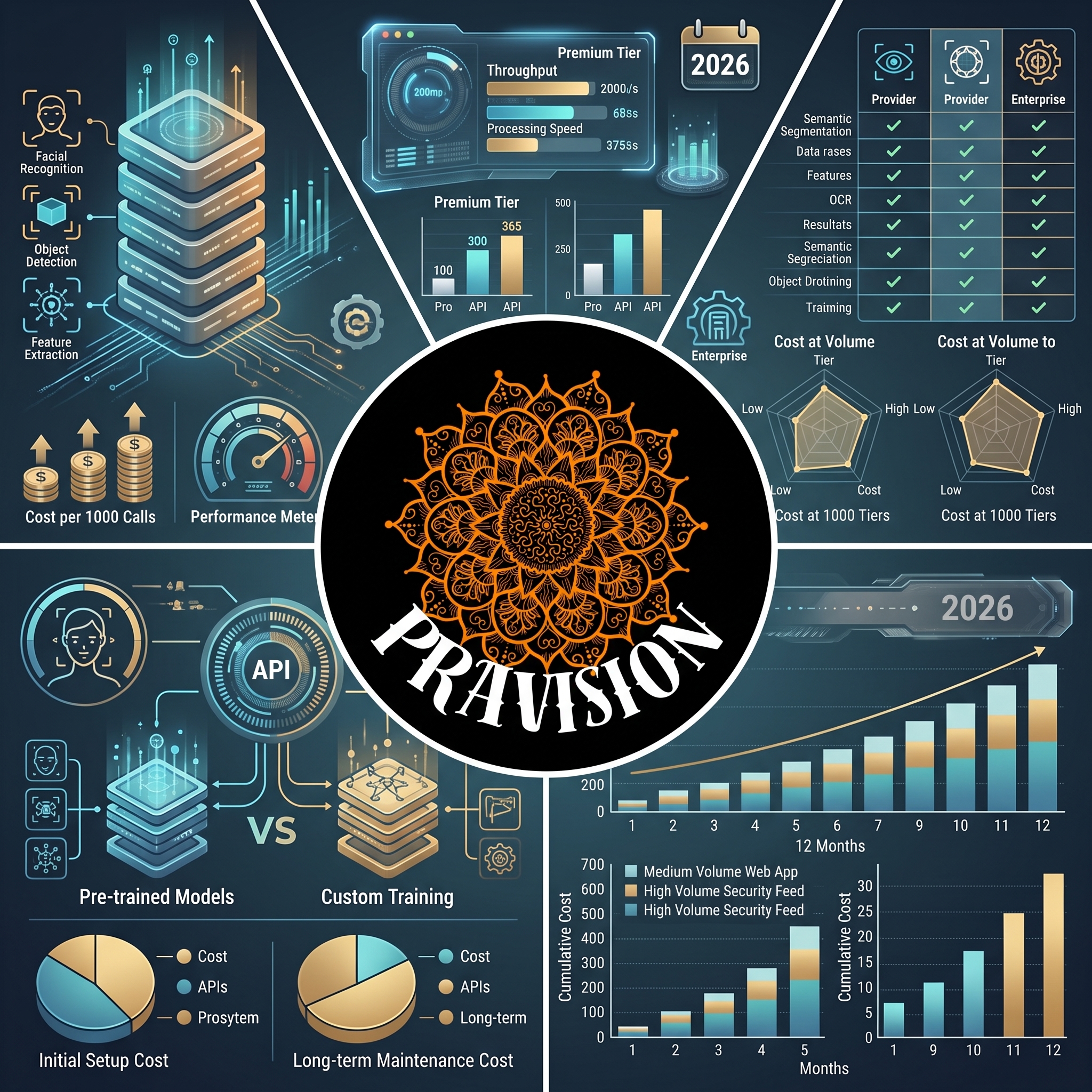
Choosing the right computer vision API can be challenging, especially when navigating the complex landscape of pricing models. This comprehensive computer vision API pricing comparison guide breaks down the costs, features, and value propositions of leading providers in 2026, helping you make an informed decision that aligns with your technical requirements and budget constraints.
Whether you’re building an e-commerce image recognition system, developing autonomous vehicle technology, or implementing facial recognition for security applications, understanding the pricing structures of major computer vision APIs is essential for project planning and long-term scalability.
Understanding Computer Vision API Pricing Models
Before diving into specific provider comparisons, it’s important to understand the common pricing structures you’ll encounter in the computer vision API market. Most providers use one or more of the following models:
- Pay-per-request: You’re charged for each API call, with prices typically decreasing at volume tiers
- Monthly subscriptions: Fixed monthly fees with included request quotas
- Freemium models: Free tiers with limited requests, then paid upgrades
- Enterprise custom pricing: Negotiated rates for high-volume users
- Feature-based pricing: Different rates depending on which vision capabilities you use
The optimal pricing model depends on your usage patterns, transaction volume, and whether you need consistent baseline access or have variable demand. Many developers start with freemium tiers during development and prototyping, then transition to paid plans as their applications scale.
Major Computer Vision API Providers: Detailed Pricing Breakdown
Google Cloud Vision API
Google Cloud Vision remains one of the most comprehensive options in 2026, offering features like label detection, face detection, OCR, and explicit content detection. Their pricing structure includes:
- Free tier: 1,000 units per month across most features
- Label detection: $1.50 per 1,000 images (first 1M/month), decreasing to $0.60 for volumes over 5M
- OCR: $1.50 per 1,000 images with similar volume discounts
- Face/landmark detection: $1.50 per 1,000 images
- Product search: Higher rates at $2.50-$3.75 per 1,000 images depending on volume
Google’s strength lies in its integration with the broader Google Cloud ecosystem and consistent performance across diverse image types.
Amazon Rekognition
Amazon’s computer vision service offers competitive pricing with strong integration into AWS services. Current 2026 pricing includes:
- Free tier: 5,000 images per month for the first 12 months
- Image analysis: $1.00 per 1,000 images (first 1M/month), dropping to $0.40 for over 10M
- Face detection/analysis: $1.00 per 1,000 images processed
- Custom labels: $4.00 per hour for training, plus $4.00 per 1,000 inference images
- Video analysis: Separate pricing at $0.10 per minute analyzed
Amazon Rekognition excels for organizations already invested in the AWS ecosystem, offering seamless integration with S3, Lambda, and other AWS services.
Microsoft Azure Computer Vision
Microsoft Azure provides robust computer vision capabilities with transparent pricing tiers updated for 2026:
- Free tier: 5,000 transactions per month with rate limits
- Standard tier: $1.00 per 1,000 transactions (0-1M), decreasing to $0.65 for 1M-10M, and $0.40 for over 100M
- Spatial analysis: $0.07 per camera per hour for real-time video analytics
- Custom Vision: Separate training costs at $2 per hour, plus prediction costs
Azure’s computer vision services integrate particularly well with Microsoft’s enterprise offerings and provide strong support for on-premises deployment scenarios.
Clarifai
Clarifai focuses on customizable AI models with flexible pricing that has evolved significantly in 2026:
- Community tier: Free with 1,000 operations per month
- Essential: Starting at $30/month for 3,000 operations
- Professional: Custom pricing based on volume and features
- Operations pricing: Varies by model complexity, typically $0.40-$2.40 per 1,000 operations
Clarifai stands out for businesses requiring highly customized models and industry-specific computer vision applications.
Computer Vision API Pricing Comparison: Key Factors Beyond Cost
When conducting a thorough computer vision API pricing comparison, the sticker price is only one consideration. Several other factors significantly impact total cost of ownership and value:
Accuracy and Performance
A cheaper API that requires multiple attempts to achieve acceptable accuracy may ultimately cost more than a premium service with higher first-pass success rates. Benchmark testing with your specific image types is crucial before committing to a provider.
Feature Coverage
Some providers excel at specific tasks. If you need multiple capabilities (OCR, object detection, and facial recognition), bundling with a single provider may offer better value than mixing services, despite potentially higher per-feature costs.
Latency and Reliability
For real-time applications, API response times and uptime guarantees matter significantly. Enterprise SLAs typically cost more but provide guaranteed performance levels critical for production applications.
Data Privacy and Compliance
GDPR, CCPA, and industry-specific regulations may require specific data handling practices. Providers offering on-premises deployment or enhanced privacy features often charge premium rates but may be necessary for compliance.
Cost Optimization Strategies for Computer Vision APIs
Regardless of which provider you choose, implementing these strategies can significantly reduce your computer vision API costs:
- Batch processing: Group image processing requests when real-time results aren’t required
- Image preprocessing: Optimize image sizes and formats before API calls to reduce processing costs
- Caching results: Store and reuse results for duplicate or similar images
- Tiered feature usage: Use less expensive basic detection first, then call advanced features only when needed
- Volume commitment: Negotiate annual contracts for predictable savings on high-volume usage
- Multi-provider strategy: Use different APIs for different tasks based on pricing and accuracy sweet spots
- Edge processing: Consider on-device computer vision for high-volume scenarios to eliminate per-request costs
Many organizations find that a hybrid approach—combining cloud APIs for complex tasks with on-device processing for simpler operations—delivers optimal cost-performance balance.
Emerging Trends in Computer Vision API Pricing for 2026
The computer vision API landscape continues evolving rapidly. Several trends are shaping pricing strategies in 2026:
Specialized model pricing: Providers increasingly offer industry-specific models (medical imaging, retail, manufacturing) with premium pricing reflecting specialized training data and higher accuracy for niche applications.
Sustainability-based pricing: Some providers now offer pricing incentives for using energy-efficient inference endpoints and carbon-neutral processing regions as environmental concerns influence technology purchasing decisions.
Real-time processing premiums: As edge computing and 5G enable more real-time computer vision applications, providers are differentiating pricing between batch and real-time processing, with premiums for guaranteed low-latency responses.
Custom model training democratization: Training costs for custom models have decreased significantly, making specialized computer vision more accessible to smaller organizations and startups.
Making Your Computer Vision API Pricing Decision
When finalizing your computer vision API selection, create a weighted scorecard evaluating:
- Base pricing aligned with your expected monthly volume
- Feature completeness for your specific use cases
- Performance benchmarks using your actual image data
- Integration complexity with your existing technology stack
- Scalability as your application grows
- Support quality and documentation comprehensiveness
- Compliance with your regulatory requirements
Remember that the cheapest option rarely proves most cost-effective long-term. Factor in developer time, maintenance overhead, and opportunity costs when comparing providers. Many successful implementations start with proof-of-concept testing across 2-3 providers using real production data before making final commitments.
The computer vision API pricing comparison landscape in 2026 offers more choices and better value than ever before, with major providers competing aggressively on both features and cost. By thoroughly understanding your requirements, testing thoroughly, and selecting the provider that best aligns with your technical and business needs, you can implement powerful computer vision capabilities while maintaining cost efficiency.
Frequently Asked Questions
What is the cheapest computer vision API in 2026?
While pricing varies by usage patterns, Clarifai’s Community tier and Google Cloud Vision’s generous free tier (1,000 requests/month) offer the lowest entry points. For production volumes, Amazon Rekognition often provides the best value for basic image analysis at $1.00 per 1,000 images for moderate volumes, decreasing significantly at scale.
Do computer vision APIs charge for failed requests?
Most major providers (Google, Amazon, Microsoft, Clarifai) only charge for successfully processed requests. However, improperly formatted requests that consume server resources may count toward rate limits. Always review each provider’s specific billing policies, as practices vary for timeout errors and partial processing scenarios.
Can I switch computer vision API providers without major code changes?
Switching providers typically requires moderate development effort, as each API has unique request formats, response structures, and authentication methods. However, abstracting your computer vision calls behind a service layer during initial development minimizes switching costs. Consider multi-provider support from the start if vendor flexibility is important.
Are there open-source alternatives to commercial computer vision APIs?
Yes, open-source frameworks like OpenCV, TensorFlow, and PyTorch enable self-hosted computer vision without per-request fees. However, you’ll incur infrastructure costs, model training expenses, and significant development time. Commercial APIs typically offer better value unless you have very high volumes (millions of requests monthly) or highly specialized requirements.
How do I estimate my monthly computer vision API costs?
Start by estimating your monthly image processing volume, then identify which specific features you’ll use (basic labeling costs less than specialized analysis). Most providers offer pricing calculators on their websites. For new applications, monitor actual usage during beta testing—costs often differ significantly from initial estimates as real user behavior emerges.