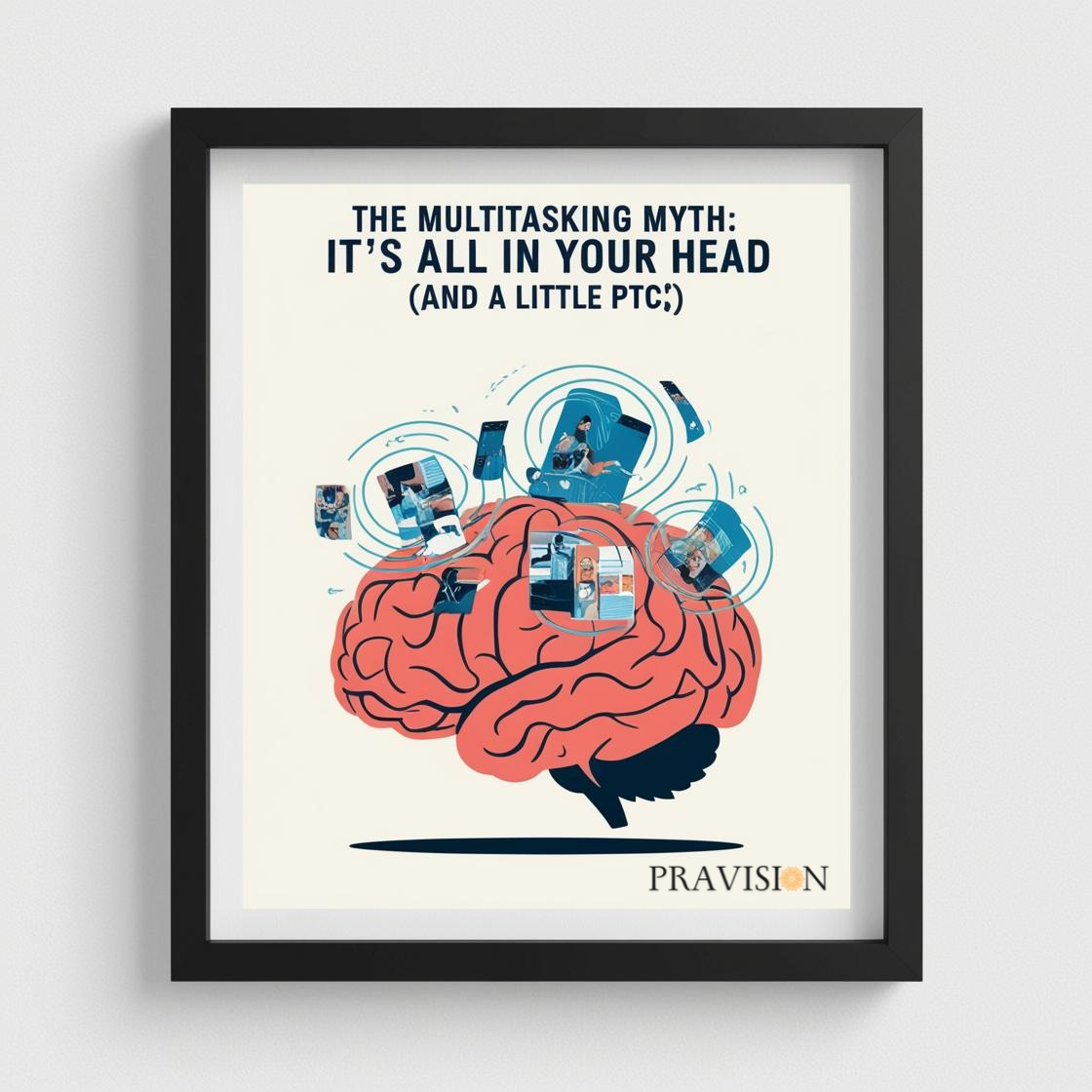

The Multitasking Myth: It’s All in Your Head (and a Little PTC)
The age-old debate rages on: are men or women better multitaskers? We’ve all heard the theories about brain structure and hormonal influences, but I have a different take. My theory? It’s all in their mind.
I recently had a firsthand experience that solidified this belief. I was trying to watch a show, but I was completely lost. The plot points weren’t connecting, and I felt like I was missing something crucial. Then, almost instinctively, I opened my laptop and started working while the show played in the background. Something surprising happened. Suddenly, the show started to make sense! I was following the story, understanding the nuances, and actually enjoying it.
It was as if my brain needed more stimulation to focus. When I tried to concentrate solely on the show, my mind felt empty, restless. There was too much “free space,” and my attention kept wandering. But by engaging in two tasks simultaneously – watching the show and working on my laptop – I achieved a strange kind of equilibrium. I was able to type effectively, often without even looking at the keys, and absorb the show’s narrative simply by listening.
Now, does this mean multitasking reduces productivity? Not necessarily. In my case, it actually enhanced my understanding of the show. And the typing? Muscle memory and practice took over. It wasn’t a conscious effort. The key here is that I wasn’t truly “multitasking” in the traditional sense of actively focusing on both tasks at 100% capacity at the exact same moment. Instead, my brain was seamlessly shifting between them, allowing me to process information in a more holistic way.
This brings me to the core of my theory. Multitasking isn’t an innate ability; it’s a learned skill. We aren’t born with it. We develop it through practice. Just like learning to ride a bicycle or play an instrument, multitasking requires consistent effort and training. Did we all nail it the first time we hopped on a bike? Absolutely not. We wobbled, we fell, we scraped our knees. But we kept practicing, and eventually, we learned.
The same applies to multitasking. If someone, whether man or woman, struggles to multitask, it likely means they haven’t practiced it enough, or perhaps they haven’t even tried. The common notion that “men can’t multitask” is, in my opinion, a misconception born from a lack of practice. Have they truly tried? Have they practiced consistently?
I believe the key to successful multitasking lies in what I call PTC: Practice, Train, Continuous. It’s about consistently practicing different task combinations, training your brain to switch seamlessly between them, and maintaining this practice continuously.
So, I challenge you: if you think you can’t multitask, try it. Start small, with simple combinations. Practice consistently. Train your brain. You might surprise yourself. And if you’ve already mastered the art of juggling multiple tasks, share your experiences in the comments here! What are your PTC tips? What combinations work best for you? Let’s unlock the secrets of the multitasking mind together.
SHARE :
Facebook
Twitter
LinkedIn

Written By
Praveena Jogi