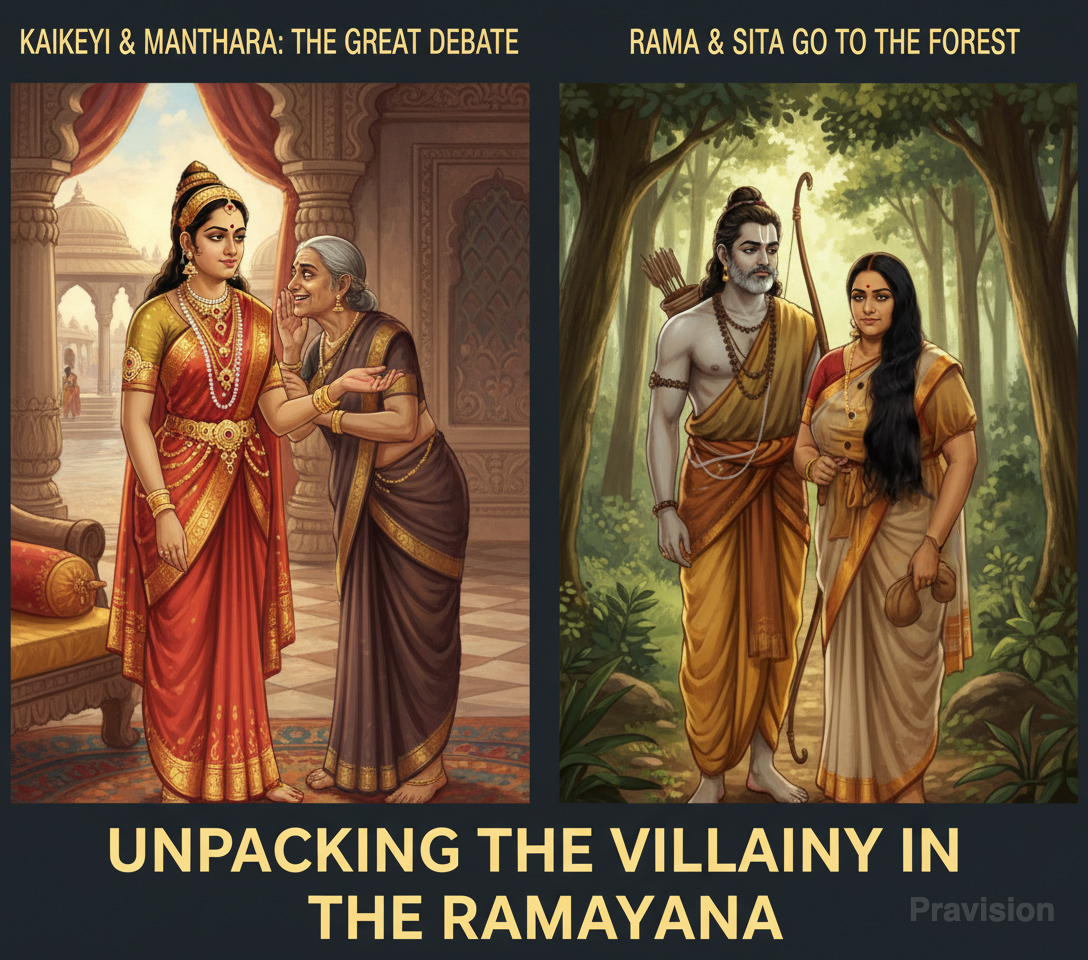

The Great Debate
Kaikeyi or Manthara
During a recent ladies’ evening, amidst the usual lively chatter, an unexpected topic completely seized the room: Who is the true villain of the Ramayana—Queen Kaikeyi or the maid Manthara?
You might wonder why such a deep, ancient epic found its way into a modern party, but the truth is, the topic was instantly captivating. It sprang up when a friend described her challenge in teaching Bala Vihar. To engage today’s kids in stories like the Ramayana, she has to contextualize the lessons in modern life. As an activity, she posed this very question to her students: Who is the bad person?
The results, both in her classroom and at our party, were striking: Approximately 90% chose Kaikeyi, and 10% chose Manthara.
Meet the Instigators
To set the stage:
-
Manthara: The cunning, hunchbacked maid. She is the initial poison, the one who plants seeds of jealousy and suspicion in the Queen’s mind. She is the architect of the tragedy.
-
Kaikeyi: The youngest and once-beloved Queen, mother of Bharata. Before the banishment, she was known for her deep affection for Rama. She is the executor of the tragedy, the one who ultimately forces the devastating demand upon the King.
Why the Majority Blames Kaikeyi
The argument for Kaikeyi’s greater guilt relies on the principle of accountability. As a Queen and a mother, she had the ultimate authority. Manthara could only suggest, but Kaikeyi chose to act. She allowed a single person’s jealous counsel to override her lifelong love for Rama and her husband, Dasharatha. Even if Manthara planted the seed, Kaikeyi was the fertile ground.
Why the Minority Sides with Manthara
Those who blame Manthara focus on causation. Without Manthara’s persistent, malicious effort, Kaikeyi would have happily seen Rama crowned. Manthara introduced the idea of royal injustice where none existed. In this view, Kaikeyi was a vulnerable victim of psychological warfare—not acting as herself, but as a tool of Manthara’s malice.
The “Karmic/Divine” Perspective: The Destiny Argument
Beyond the human drama lies a deeper layer often discussed in traditional circles: The Destiny Argument. In many retellings, it is believed that the gods intervened to ensure the higher purpose of Rama’s incarnation was fulfilled. It is said that the Goddess Saraswati “sat on Manthara’s tongue” or clouded Kaikeyi’s intellect to trigger the exile.
From this perspective, neither woman is a true villain; they were mere instruments of a larger cosmic plan. If Rama had not been sent to the forest, the demon-king Ravana would never have been defeated. While this doesn’t erase their earthly actions, it suggests that their “villainy” was a necessary catalyst for the triumph of Dharma.
The Final Verdict: Influence vs. Action
The debate boils down to a timeless question: Is the person who originates the evil idea worse than the person who has the power and acts upon it?
Our party agreed: While Manthara is the initial source of the poison, Kaikeyi is the greater villain. A powerful person is always accountable for the choices they make, regardless of the influence. Manthara was the whisper, but Kaikeyi was the roar that tore the kingdom apart.
Now, we turn the question over to you: Does the “Destiny Argument” change your view, or do you still hold the individuals accountable? Who do you believe is the true villain? Share your thoughts in the comments below!
SHARE :
Facebook
Twitter
LinkedIn

Written By
Praveena Jogi